


Electric motorcycle brand terminology explained clearly
You’re deep in a forum thread about upgrading your Surron, and the conversation is flying: “Just flashed the VESC with FOC, bumped the Wh, and swapped to a torque sensor.” If you nodded along while quietly wondering what half of that meant, you’re in good company. Even riders with years of seat time get tripped up by the layered vocabulary that surrounds electric motorcycle modifications. This guide breaks down the most important and misunderstood terms, brand by brand and category by category, so you can shop smarter, upgrade with confidence, and stop second-guessing every product listing.
Table of Contents
- Why brand terminology matters for electric motorcycle upgrades
- Battery specs decoded: V, Ah, and Wh in brand lingo
- Controllers and ‘VESC’: What open-source tuning really means
- Sensing and ride feel: Throttle, torque sensor, and cadence
- The terminology trap: Why decoding brand lingo beats spec chasing
- Upgrade smarter with the right parts for your brand
- Frequently asked questions
Key Takeaways
| Point | Details |
|---|---|
| Know your terms | Understanding brand-specific lingo for controllers, sensors, and batteries prevents upgrade headaches. |
| Wh defines range | Watt-hours (Wh) is the best metric for comparing battery energy and expected mileage. |
| VESC is open-source | The VESC platform allows advanced motor control tuning but requires compatible hardware. |
| Sensor style changes ride | Throttle, torque, and cadence sensors create very different riding experiences even with similar specs. |
| Right upgrade, better result | Using correct terminology helps you choose upgrades that truly match your bike’s system and your goals. |
Why brand terminology matters for electric motorcycle upgrades
Here’s a real problem that costs riders money every year: buying the wrong part because the listing used a term they didn’t fully understand. A “throttle” on a Surron is not the same experience as a “throttle” on a pedal-assist commuter bike, even though both words appear in the same forums. Brand-specific vocabulary creates invisible walls between riders who know the scene and those still learning it.
The confusion runs deep because different brands and communities borrow terms from different traditions. Off-road electric motorcycle culture pulls from dirt bike language, e-bike culture pulls from cycling, and DIY builder culture pulls from robotics and open-source electronics. When these worlds collide in a product listing or forum post, the same word can mean three different things depending on who wrote it.
Here are the most common terminology traps you’ll encounter when shopping for upgrades:
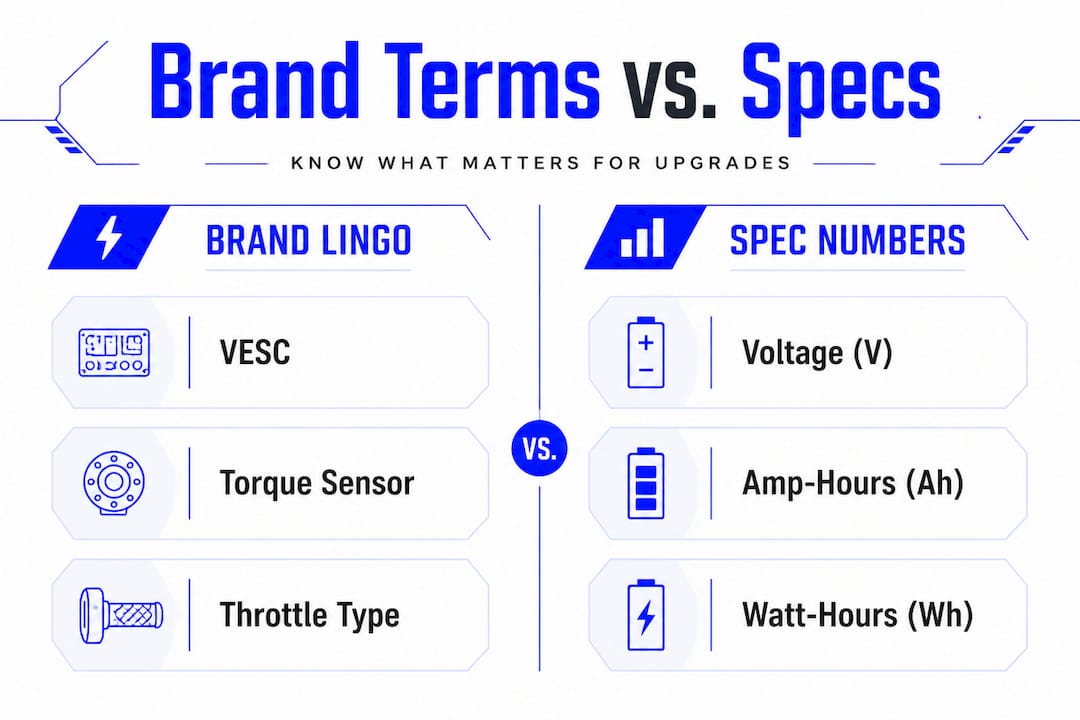
- Throttle: On electric motorcycles like the Surron, this means a direct hand-controlled input for speed, similar to a gas bike. On e-bikes, “throttle” sometimes refers to a thumb or twist input that bypasses pedaling entirely. The upgraded Surron throttle is a direct-input speed control, not a pedal-assist override.
- Torque sensor vs. cadence sensor: These describe how the system decides how much power to deliver. Electric bike glossaries define throttle as a device controlling speed and describe torque sensors vs. cadence/speed sensing as fundamentally different approaches that change ride feel and responsiveness.
- Controller: Could mean the physical box managing motor output, the firmware running on it, or both. Context is everything.
- Motor mode: On some brands, this is a software setting. On others, it refers to a physical wiring configuration.
Pro Tip: Before buying any upgrade part, search the specific brand name plus the part term together. “Surron throttle” and “e-bike throttle” return very different products with very different fitment and function.
The stakes are real. A mismatched sensor or controller can mean a bike that surges unexpectedly, delivers no power at all, or simply doesn’t communicate with your existing system. Understanding terminology is not just academic; it is the first line of defense against a frustrating and expensive mistake.
Battery specs decoded: V, Ah, and Wh in brand lingo
Battery listings are where riders most often feel overwhelmed. You’ll see numbers like “60V 30Ah” or “72V 20Ah” and wonder which one is actually better for your build. The answer lives in understanding what each unit actually measures and why one matters more than the others for real-world riding.
Voltage (V) describes the electrical pressure in the system. Higher voltage generally means the motor can spin faster and the system can deliver more peak power. Most performance electric motorcycles run between 48V and 84V, with higher-end builds pushing into the 96V range.
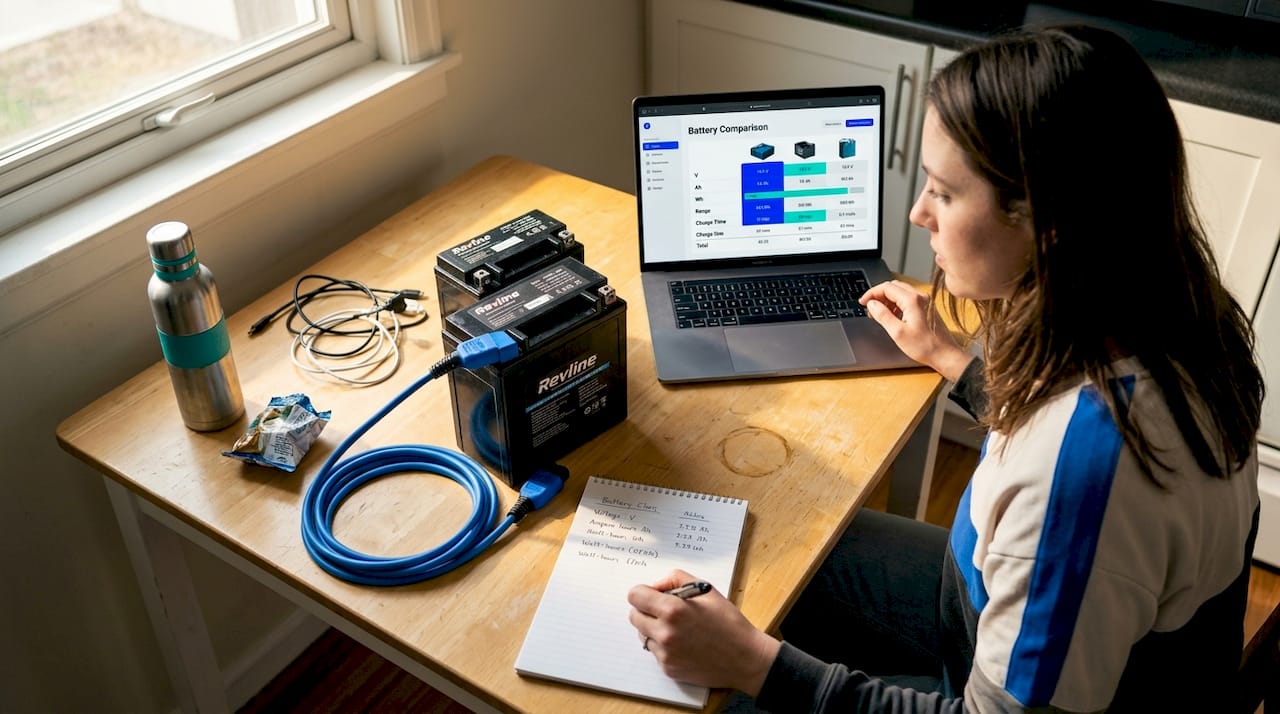
Amp-hours (Ah) measure how much current the battery can deliver over one hour. Think of it like the size of a fuel tank, but only in terms of current flow, not total energy. A 30Ah battery at 48V holds far less total energy than a 30Ah battery at 72V, which is exactly where confusion creeps in.
Watt-hours (Wh) is the number that actually tells you how much total energy the battery stores. Battery guides confirm that Wh best reflects total energy for real-world range comparisons, because it accounts for both voltage and capacity together. The formula is simple: Wh = V × Ah.
| Battery spec | Voltage (V) | Capacity (Ah) | Total energy (Wh) |
|---|---|---|---|
| Option A | 48V | 30Ah | 1,440 Wh |
| Option B | 72V | 20Ah | 1,440 Wh |
| Option C | 72V | 30Ah | 2,160 Wh |
| Option D | 60V | 25Ah | 1,500 Wh |
Options A and B have identical total energy despite looking very different on paper. Option C is the clear winner for range. Without the Wh calculation, you might assume Option B’s higher voltage makes it superior, when in reality it carries the same total energy as the lower-voltage Option A.
Pro Tip: Always calculate Wh before comparing batteries across brands. Two batteries with the same Ah rating but different voltages are not equivalent. The one with higher voltage will have more total energy and better range.
Aesthetic upgrades like the 79Bike battery lid are designed to fit specific battery pack dimensions, which is another reason understanding your battery specs matters beyond just range. If you upgrade to a physically larger pack, fitment accessories need to match.
A bigger battery is not always better, either. Higher voltage systems require compatible controllers, wiring rated for the increased current, and sometimes motor rewinding. Buying a “bigger” battery without checking system compatibility is one of the most expensive mistakes in the modification world.
Controllers and ‘VESC’: What open-source tuning really means
If battery specs are the vocabulary of range, controllers are the vocabulary of feel and performance. And no term in the controller space causes more confusion than “VESC.”
VESC stands for Vedder Electronic Speed Controller, named after Benjamin Vedder who released the original design as open-source hardware and firmware. Today, VESC is widely used as shorthand for an open-source motor-control platform associated with FOC-style control and deep tuning flexibility. It is both a specific hardware design and a broader ecosystem of compatible boards running VESC firmware.
FOC (Field-Oriented Control) is the motor control algorithm that makes VESC-based systems feel so different from basic controllers. Standard controllers use simpler switching patterns that create a slightly choppy, stepped power delivery. FOC calculates the optimal current angle in real time, producing smooth, quiet, and highly responsive power delivery across the entire RPM range. Riders describe the difference as going from a light switch to a dimmer.
| Feature | VESC / FOC controller | Proprietary controller |
|---|---|---|
| Tuning flexibility | Very high (open firmware) | Limited (manufacturer locked) |
| Community support | Large DIY community | Brand-specific forums |
| Cost | Moderate to high | Often lower upfront |
| Ride smoothness | Excellent with FOC | Varies by brand |
| Compatibility | Requires careful matching | Plug-and-play for OEM |
| Risk level | Higher (requires knowledge) | Lower for stock builds |
The risks of open firmware are real. Flashing a VESC incorrectly can damage the controller or motor. Parameter mismatches between the controller and motor specifications can cause overheating or erratic behavior. This is why brake system integrity matters so much in high-performance builds. Reliable stopping power from components like Ultra Bee brake systems is non-negotiable when you’re pushing a tuned controller to its limits.
“The controller is the brain of the build. You can have the best motor and the biggest battery, but if the controller isn’t tuned correctly, the whole system underperforms or behaves unpredictably.” — Common wisdom in the VESC builder community
For mini moto builds and lighter electric motorcycles, brakes for mini motos and front brake upgrades become especially critical when controller tuning increases peak power output beyond stock levels.
The key takeaway: VESC is not a brand name for a specific product you can drop into any build. It is an ecosystem, and compatibility requires matching motor KV rating, voltage range, current limits, and physical connector types before you even think about firmware configuration.
Sensing and ride feel: Throttle, torque sensor, and cadence
You’ve seen two builds with identical specs on paper: same motor wattage, same battery Wh, same controller brand. Yet one feels alive and responsive while the other feels sluggish and disconnected. The difference almost always comes down to sensing approach.
Here’s how the three main input and sensing systems work:
-
Throttle (direct input): The rider directly commands power output via a hand control. There is no interpretation layer. Twist or push, and the controller delivers proportional power immediately. This is the standard approach on electric motorcycles like the Surron and Talaria, and it is why upgraded throttle options are among the most popular first modifications.
-
Torque sensor: Measures the actual force applied to the pedals (on pedal-assist systems) and delivers motor assistance proportional to that force. The result feels natural and intuitive because the motor amplifies what your body is already doing. Performance-focused riders strongly prefer torque sensors for their responsiveness and precision.
-
Cadence/speed sensor: Detects whether the pedals are rotating (cadence) or uses wheel speed as a trigger. Power delivery is binary or stepped rather than proportional. The motor turns on when pedaling is detected and turns off when it stops. It works, but it lacks the nuance of a torque sensor.
“Speed sensors vs. torque sensors and throttle style affect ride feel so dramatically that the same power spec can feel completely different depending on sensing and control approach.” — Endless Sphere forum, experienced builders
The practical upgrade caution here is significant. Swapping from a cadence sensor to a torque sensor on a pedal-assist build requires controller compatibility, correct wiring, and often firmware reconfiguration. Swapping throttle types on an electric motorcycle requires matching signal voltage range and connector type. Getting either wrong means the bike either doesn’t respond at all or responds in a dangerously uncontrolled way.
Side-by-side comparison of sensing approaches makes the stakes clear. A 3,000W motor with a basic cadence sensor and a budget controller will feel slow and unresponsive off the line. The same motor with a quality torque sensor or direct throttle and a properly tuned FOC controller will feel two to three times more powerful, even though the spec sheet shows identical wattage. This is the gap between knowing the numbers and understanding the terminology behind them.
The terminology trap: Why decoding brand lingo beats spec chasing
Here’s the perspective most upgrade guides won’t give you: chasing bigger numbers is a beginner’s game. The riders who build the best machines spend their time learning vocabulary, not hunting for the highest wattage or the largest battery.
Think about it practically. Ten hours spent learning what VESC, FOC, Wh, torque sensing, and cadence sensing actually mean will save you more money and frustration than any single hardware upgrade. We’ve seen riders drop significant money on a “more powerful” battery that was actually lower in total Wh because they didn’t run the V × Ah calculation. We’ve seen throttle upgrades installed on incompatible controllers because the buyer didn’t check signal voltage range. These are not rare mistakes. They are the norm for riders who prioritize specs over understanding.
The real insight is this: two builds with identical headline numbers but different controllers and sensors will feel night-and-day different on the trail. The rider who understands why that happens can design a build that performs exactly as intended. The rider who only reads wattage and voltage numbers is essentially gambling.
Brand and scene vocabulary is your best defense against mismatched upgrades and online hype. When a forum post claims a certain controller “transforms” a Surron, the fluent modifier asks: what sensing approach does it use, what FOC parameters were tuned, and what braking system is supporting that increased power? Those questions separate informed upgrades from expensive experiments.
Mastering the lingo is the upgrade that costs nothing and pays off every time you shop.
Upgrade smarter with the right parts for your brand
Your new terminology fluency is a real advantage when it’s time to buy. You now know how to read battery listings, evaluate controller platforms, and understand what sensing approach a throttle or sensor upgrade actually delivers.
At Revline Mods, every product in our catalog is matched to specific brands and build goals. The Upgraded Surron Throttle is engineered for direct-input control on Surron builds, not a generic e-bike part relabeled for the off-road market. The Ultra Bee Brake for E-Bikes is sized and rated for the stopping demands of performance electric builds. And the Carbon Fiber Battery Lid is designed specifically for 79Bike fitment, so you’re not guessing on clearance or mounting. If you’re ever unsure about compatibility, reach out before you buy. Getting the right part the first time is always faster than a return.
Frequently asked questions
What does Wh mean, and why is it better than Ah for comparing batteries?
Wh (watt-hours) measures total battery energy using the formula Wh = V × Ah, making it the most accurate metric for real-world range comparisons because it accounts for both voltage and capacity. Battery guides confirm that Wh is the preferred standard when comparing batteries across different voltage systems.
Is VESC really open-source, and can I use it with any brand controller?
VESC is open-source firmware and hardware, but compatibility depends on your motor’s KV rating, voltage range, and current limits. Technical sources confirm VESC is a flexible open platform, but always verify your specific controller supports VESC firmware before purchasing.
What’s the difference between torque sensors, cadence sensors, and throttles?
Torque sensors measure applied pedal force for natural, proportional power delivery; cadence sensors detect pedal rotation for simpler on/off assistance; and throttles are direct hand-controlled inputs. Electric bike glossaries define all three as distinct input methods with meaningfully different effects on ride feel.
Why do two bikes with the same power feel different?
Sensor type and controller tuning determine how power is actually delivered, not just the advertised wattage. As experienced builders note, speed sensors vs. torque sensors and throttle style create dramatically different ride experiences even when headline power specs are identical.