


Electric motorcycle tuning: Techniques, upgrades, and tips
Most riders assume electric motorcycle tuning is purely about chasing top speed or squeezing out a few extra miles per hour. That assumption misses the bigger picture entirely. Tuning is a precise, layered process that shapes how your bike accelerates, how smoothly it decelerates, how efficiently it uses battery power, and how confidently it handles under load. Whether you ride a Surron, Talaria, or 79Bike, understanding the full scope of tuning transforms you from someone who just rides into someone who truly controls their machine.
Table of Contents
- What is electric motorcycle tuning?
- The expert tuning process: Step-by-step breakdown
- Key tuning parameters and how they affect performance
- Aftermarket upgrades: Parts and customization for tuners
- Our expert take: Why careful, incremental tuning beats ‘max settings’
- Ready to elevate your electric motorcycle? Shop proven upgrades
- Frequently asked questions
Key Takeaways
| Point | Details |
|---|---|
| Iterative tuning is essential | Step-by-step adjustments optimize performance while protecting your motorcycle from damage. |
| Hardware and software matter | Effective tuning balances controller settings and the right aftermarket parts for your needs. |
| Safety before performance | Always check mechanical and electrical health before making power adjustments. |
| Regenerative braking adds value | Tuning regen systems unlocks energy efficiency and improves overall ride quality. |
| Incremental upgrades win | Gradual increases backed by data outperform the risks of ‘max settings’ in reliability and control. |
What is electric motorcycle tuning?
Tuning an electric motorcycle means making deliberate adjustments to both the software settings and the physical hardware to optimize how the bike performs. It is not a single switch you flip. It is a series of calibrated decisions that shape everything from throttle response to battery protection thresholds.
On the software side, tuning involves reprogramming the motor controller, which is the brain of your drivetrain. You set current limits (how many amps the motor draws), configure throttle curves, and adjust regenerative braking strength. On the hardware side, you might upgrade a throttle sensor for better precision, install a high-performance brake kit, or swap in a more capable controller that supports wider tuning ranges.
The core goals of tuning include:
- Optimizing power delivery so torque comes in smooth and predictable, not in sharp, uncontrollable surges
- Protecting the battery and motor by staying within safe current and temperature thresholds
- Improving ride feel through throttle mapping adjustments that match your riding style
- Maximizing efficiency so you get more range without sacrificing power where you need it
- Enhancing regen braking for both energy recovery and better deceleration control
Understanding brand-specific terminology is critical before you start, because parameters vary significantly across controllers and platforms. One controller’s “current limit” setting may behave differently from another’s, even if the label looks the same.
The process is iterative and hardware-aware, meaning you never make one change and call it done. You adjust, test, monitor, and refine. That cycle is what separates a well-tuned machine from one that runs poorly or fails early. For deeper context on what specific adjustments accomplish, our DIY performance upgrade guide breaks down common modifications and their real-world effects.
The expert tuning process: Step-by-step breakdown
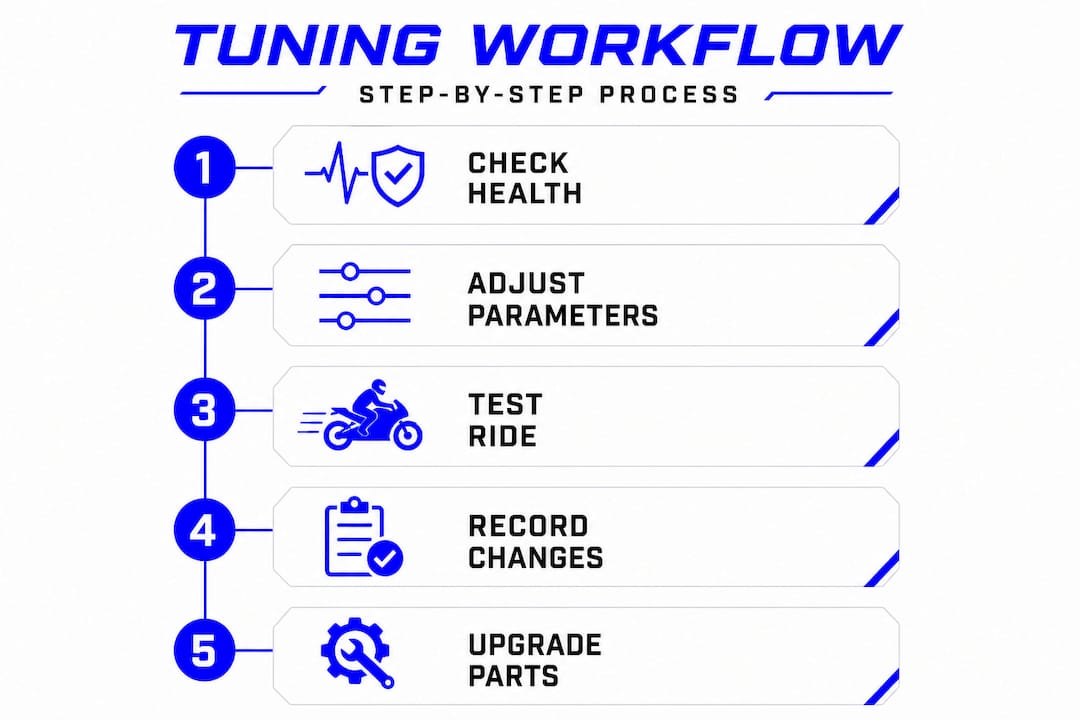
Practical tuning methodology follows a clear hierarchy: verify mechanical and electrical health first, then dial in current and power limits, refine throttle mapping for ride feel, then configure regen and efficiency settings while monitoring heat and behavior under repeated pulls. Skipping steps in this sequence is how motors get burned and controllers get fried.
Here is the expert sequence:
- Inspect mechanical and electrical health. Check motor connections, battery terminals, phase wire condition, and sensor wiring. A loose phase wire will cause erratic behavior that no software fix can address. Clean contacts and verify no shorts before touching any software.
- Set conservative base current limits. Start at 60 to 70 percent of your controller’s rated capacity. This protects the motor from heat stress while you gather baseline data. You can always increase limits once you confirm stable behavior.
- Verify sensor alignment. Hall sensors or encoder feedback must be correctly calibrated for Field-Oriented Control (FOC), a motor control method that optimizes efficiency and smoothness. Misaligned sensors cause vibration, cogging, or runaway behavior under load.
- Adjust throttle mapping. Use your controller software to shape the throttle curve. A linear curve gives proportional response. An exponential curve loads torque later in the twist, which is friendlier for trail riding. A logarithmic curve front-loads power delivery for aggressive launches.
- Configure regenerative braking. Set regen strength to a level that feels natural. Too strong and it throws the rear end on off-road terrain. Too weak and you lose meaningful energy recovery on longer rides.
- Run repeated test pulls and monitor temperature. Motor temperature and controller temperature should stabilize, not keep climbing. If heat builds without leveling off, reduce current limits before pushing further.
Pro Tip: Document every parameter change in a notebook or spreadsheet. When something works or breaks, you will know exactly what caused it. Riders who skip documentation spend hours trying to recreate a setting that worked perfectly last weekend.
Our hardware modification guide walks through the physical side of this process, including how to safely access controller settings on popular electric motorcycle platforms.
Key tuning parameters and how they affect performance
Understanding which parameters move the needle and how they interact is what separates real tuners from people who just change numbers randomly. Each parameter has trade-offs, and pushing one often pulls another in the opposite direction.
| Parameter | Performance impact | Efficiency impact | Risk if maxed |
|---|---|---|---|
| Battery current limit | Higher acceleration, more torque | Lower efficiency | Battery sag, overheating |
| Motor current limit | Raw power output | Moderate efficiency loss | Motor overheating, demagnetization |
| Throttle curve | Ride feel, response speed | Minimal | Wheel spin, instability |
| Regen strength | Deceleration, energy recovery | Improves range | Rear lock-up on loose terrain |
| Traction control threshold | Consistent grip and power delivery | Slight efficiency gain | Loss of feel if set too tight |
Current limits directly control how aggressively the motor pulls. Raising the motor current limit increases torque output, which means faster acceleration off the line. But higher current also generates more heat. A motor running hot for extended periods degrades its winding insulation over time, eventually causing shorts that destroy the motor entirely.
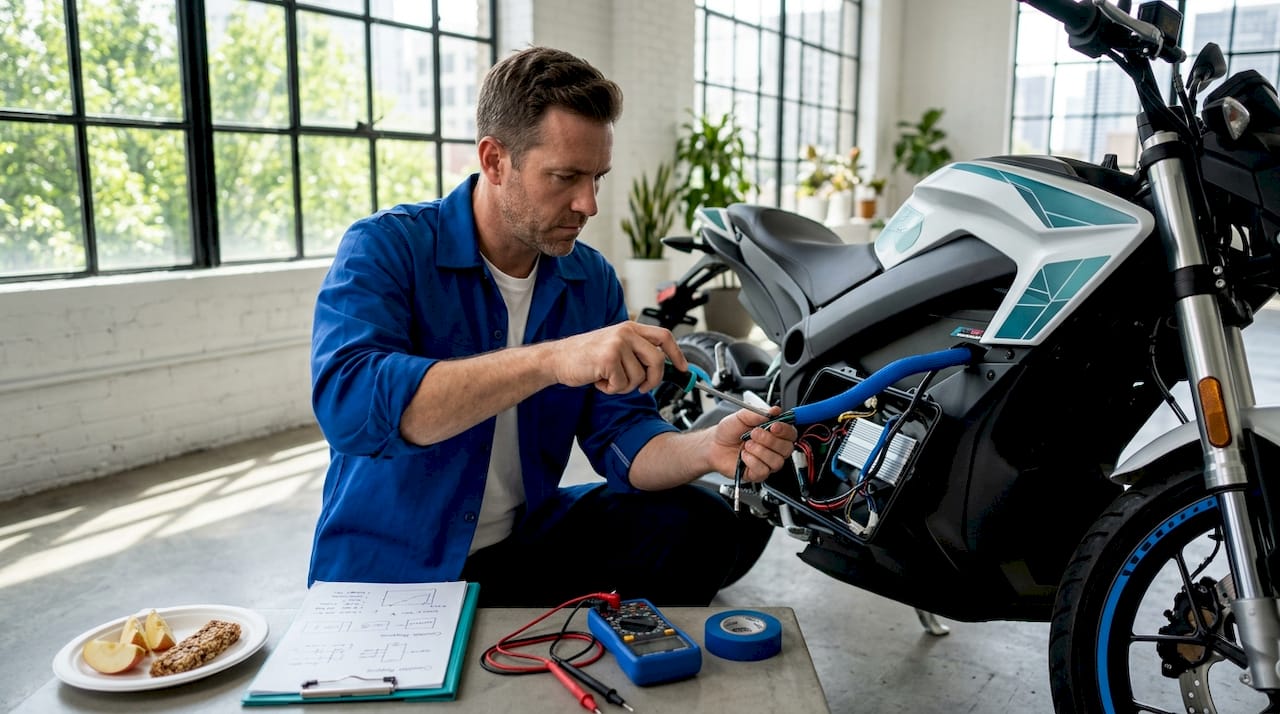
Throttle mapping is one of the most rider-specific adjustments you can make. Experienced riders often prefer a slightly delayed, logarithmic curve for technical trail riding because it gives precise low-speed control. Track riders tend to favor a more aggressive linear or exponential curve for explosive launches out of corners. Your upgraded Surron throttle hardware plays a role here too, because a higher-resolution throttle sensor gives the controller more data points to work with, translating to finer throttle granularity.
Regenerative braking is one of the most undertuned parameters in the community. Control algorithms for regen braking are actively studied and evaluated against real-world driving cycles because getting this balance right significantly impacts both range and ride safety. Set it too high and you get unpredictable deceleration. Set it correctly and you gain meaningful range without compromising stability.
“Getting regen and torque control right isn’t just about energy savings — it’s about predictable, safe handling that riders can actually trust at speed.”
Integrating quality braking hardware, like the Ultra Bee brake system, ensures your physical braking force works in harmony with your software-configured regen thresholds rather than fighting against them.
Aftermarket upgrades: Parts and customization for tuners
Knowing how to tune parameters is powerful. But the ceiling of what software tuning can achieve is determined by your hardware. Aftermarket parts raise that ceiling dramatically.
Iterative tuning proceeds from current limit setup through to advanced control features, and each hardware upgrade you install expands what those advanced features can actually do. Here is a breakdown of the most impactful aftermarket upgrades:
| Upgrade category | What it improves | Example benefit |
|---|---|---|
| Controller | Tuning range, FOC accuracy | Access to higher current limits safely |
| Throttle sensor | Resolution and linearity | Smoother, more precise power delivery |
| Brake system | Modulation and regen integration | Better energy recovery and stopping power |
| Suspension | Traction and stability | Optimized power delivery to the ground |
| Wheels and tires | Grip and rolling resistance | Better launch traction and range efficiency |
Key aftermarket upgrades worth prioritizing include:
- High-capacity controllers that support wider current ranges and advanced FOC algorithms, giving you room to tune without immediately hitting hardware limits
- Precision throttle sensors that eliminate dead zones and provide consistent signal output across the full twist range
- Performance brake kits that integrate cleanly with regen settings, giving you predictable combined braking without feedback conflicts
- Supermoto or trail-specific wheelsets that match tire profiles to riding conditions, ensuring your tuned power output actually reaches the ground effectively
- Upgraded motor mounts and heat sinks that extend motor life when running higher current settings
For off-road builds specifically, our trail performance tips cover how suspension and wheel upgrades work together with tuned power delivery for maximum trail performance.
Brakes deserve special attention here. Riders often overlook the relationship between physical brake force and regen braking. If your brake system does not modulate well, your regen settings become harder to calibrate because the feedback loop between lever input and deceleration becomes inconsistent.
The Surron platform, in particular, responds extremely well to combined software and hardware upgrades. Check out the Surron upgrades and features guide for a platform-specific breakdown of what modifications produce the most noticeable results.
Our expert take: Why careful, incremental tuning beats ‘max settings’
Here is the uncomfortable truth that the loudest voices in tuning forums rarely acknowledge: chasing maximum settings is a beginner’s mistake dressed up as ambition. We have seen it play out dozens of times. Rider gets a new controller, cranks everything to 100 percent, rides hard for two weeks, then burns a motor winding or fries a phase wire. Then they ask why their bike “just stopped working.”
Expert tuning is iterative precisely because hardware has tolerance bands, not fixed breaking points. A motor rated for 80A continuous might handle 100A in short bursts on a cool day. On a hot day, after 30 minutes of hard riding, that same 100A setting might push it past the edge. The rating tells you the average. Only careful incremental testing reveals your specific bike’s real limits under your specific conditions.
Incremental tuning also gives you something max settings never can: a clear record of what changed and why the bike feels different. When you raise current limits by 5A at a time and test between each change, you know exactly at what point throttle response became snappier. You know where heat started climbing faster. That data is worth more than any single aggressive setting.
Riders who follow structured DIY tuning processes consistently report longer component lifespans alongside better performance. That is not a coincidence. Measured tuning preserves motor and controller life because you never unknowingly cross thermal or electrical limits without noticing first.
Pro Tip: Keep a simple log with date, parameter changed, value before, value after, and ride notes. After three or four sessions you will have a clear picture of your bike’s personality under different conditions.
The most dialed-in builds we have seen are never the ones chasing the biggest numbers. They are the ones where every parameter serves a purpose, every upgrade was chosen deliberately, and the rider knows their machine deeply because they built that knowledge one change at a time.
Ready to elevate your electric motorcycle? Shop proven upgrades
After exploring the logic and mechanics of electric motorcycle tuning, the natural next step is putting quality hardware behind your knowledge.

At Revline Mods, we stock the specific parts that make tuning more effective and more reliable. From a precision upgraded throttle that gives your controller more accurate input data, to the Ultra Bee brake system that integrates cleanly with your regen configuration, every product in our catalog is chosen with the tuning-focused rider in mind. If you are looking to complete a supermoto build or improve traction for tuned power delivery, our 17" supermoto wheelset pairs performance and fitment for popular electric motorcycle platforms. Shop with confidence knowing our team understands your build goals from the ground up.
Frequently asked questions
What is the first step in electric motorcycle tuning?
Check the mechanical and electrical health of your motorcycle before adjusting performance settings. Practical tuning methodology requires confirming all wiring, sensors, and connections are sound before touching software parameters.
Can tuning improve regenerative braking efficiency?
Yes, proper tuning lets you optimize regen strength for both energy recovery and smoother ride feel. Control algorithms for regen braking are evaluated against real driving cycles, confirming that calibrated regen settings produce measurable efficiency gains.
Are aftermarket parts necessary for electric motorcycle tuning?
Not required, but quality aftermarket parts expand your tuning ceiling and help achieve better performance safely. Iterative, hardware-aware tuning advances further when the hardware can support higher current limits and more precise sensor feedback.
How can I tune my throttle for smoother response?
Use controller software alongside aftermarket throttle hardware to map sensitivity to your preferred ride feel. Throttle mapping is one of the first parameters dialed after current limits are verified stable.
Is it safe to use maximum settings for all parameters?
No, maxing all settings risks overcurrents and unpredictable failures. Iterative current limit setup with sensor verification before advancing to high-performance settings is the safe and proven approach.