


Off-Road Electric Vehicle Terminology: 2026 Guide
Off-road electric vehicle terminology is the specialized set of jargon that combines electric drivetrain technology with traditional off-road mechanics, and knowing it separates confident riders from confused ones. Terms like torque vectoring, BMS, state of charge, and articulation now appear alongside classic off-road vocabulary like locking differentials and ground clearance. Vehicles such as the Rivian R1T, GMC Hummer EV, and electric trail bikes from Surron and Talaria have pushed this hybrid vocabulary into everyday use. This guide defines the most important electric off-road vehicle terms clearly, so you can ride, wrench, and communicate with authority.
What is off-road electric vehicle terminology?
Off-road EV terminology covers two overlapping domains: electric vehicle tech and traditional four-wheel-drive mechanics. The electric side contributes terms like kilowatt-hours (kWh), battery management system (BMS), DC fast charging, and regenerative braking. The off-road side brings locking differentials, articulation, ground clearance, and suspension travel. Where these two domains meet, you get EV-specific concepts like torque vectoring, independent motor control, and thermal preconditioning. Understanding electric motorcycle basics is the foundation before tackling the more advanced jargon.
The terminology matters practically. When a trail buddy says “engage the rear locker before the rock garden” or a spec sheet lists “14.9 inches of ground clearance with active air suspension,” you need to parse both the mechanical and electrical meaning instantly. Misreading a term like “one-pedal driving” on a steep descent can be the difference between controlled braking and a runaway situation.
Key drivetrain and traction terms in off-road electric vehicles
Drivetrain vocabulary is where off-road EV jargon diverges most sharply from gas-powered vehicles. These are the terms you will encounter most often when reading specs, watching trail builds, or talking to other riders.
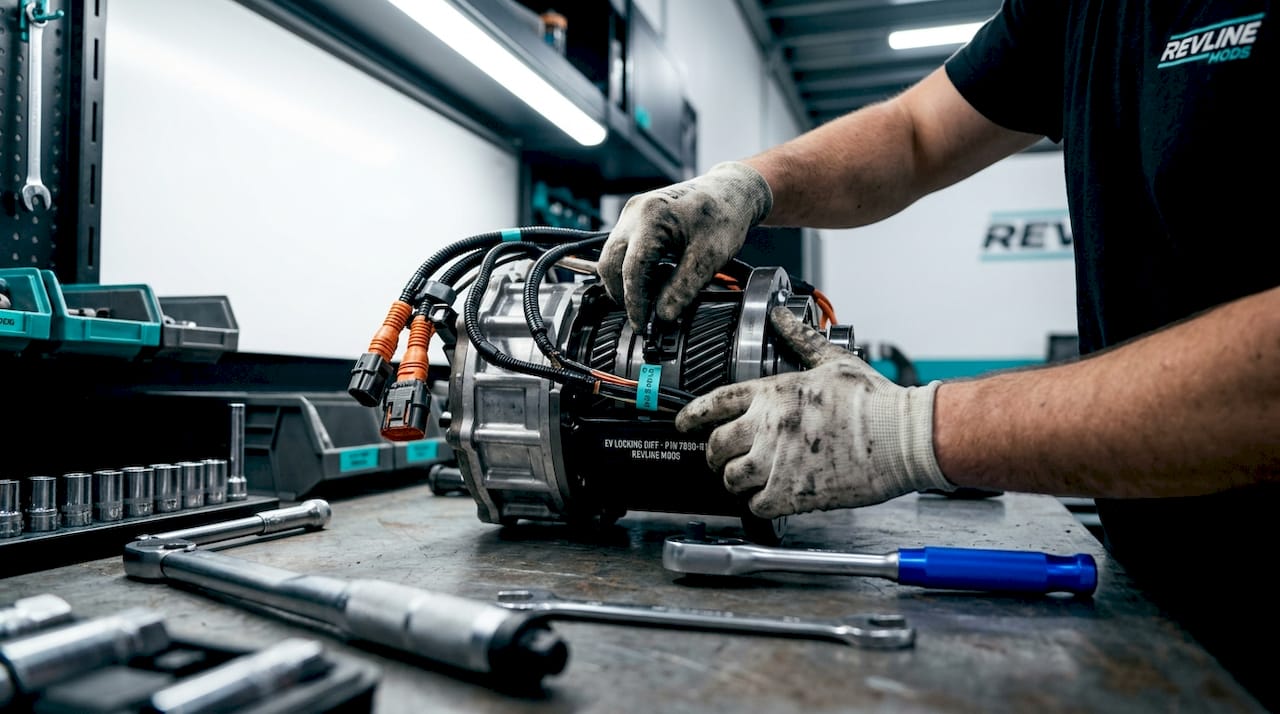
Locking differential (locker): A locking differential forces both wheels on an axle to spin at the same speed, solving the classic problem where an open differential sends all torque to the wheel with the least grip. On a slippery rock shelf, that means both rear wheels pull equally instead of one spinning uselessly in the air. A rear locker alone solves 80 to 90% of off-road traction problems. Electronic lockers, which engage almost instantly using electromagnets or small motors, are now standard on trail-focused EVs and are far simpler to operate than older mechanical or air-actuated designs.
Torque vectoring: This term describes a system that actively distributes torque between wheels to improve traction and cornering. In EVs, torque vectoring implementations fall into three categories: multi-motor control (each wheel has its own motor), electronic limited slip differential (e-LSD), and brake-based vectoring (braking individual wheels to redirect torque). Multi-motor systems are the most capable. Rivian’s quad-motor setup, for example, can perform a tank turn by spinning opposite wheels in opposite directions, a maneuver physically impossible with any mechanical differential.
Independent motor control: This is the EV-specific advantage that has no direct gas-powered equivalent. Each motor responds to its own torque command in milliseconds, faster than any mechanical system. On a loose hillside, the system can reduce torque to a spinning wheel and increase it to the gripping wheel without the driver doing anything. That said, torque vectoring authority is still limited by physical grip. Software cannot create traction that the tire-to-ground contact does not allow.
Here are the core drivetrain terms you need to know:
- Open differential: Splits torque equally but allows wheels to spin at different speeds. Fails when one wheel loses grip entirely.
- Locked differential: Forces equal wheel speed. Best for low-speed technical terrain.
- e-LSD (electronic limited slip differential): Partially limits speed difference between wheels. A middle ground between open and locked.
- Quad-motor system: Four independent motors, one per wheel. Maximum traction and vectoring capability.
- Crawl ratio: The effective gear reduction at the wheels during low-speed off-road use. EVs achieve this electronically rather than through a transfer case.
Pro Tip: Engage lockers before you need them, not after you are already stuck. Electronic lockers on EVs disengage on pavement automatically on some models, but always verify before highway driving to avoid drivetrain stress and tire wear.
Battery, charging, and thermal management terms for off-road EVs
Battery vocabulary is the part of off-road EV jargon that most newcomers find overwhelming. These terms directly affect how far you can ride, how fast you can recharge, and whether your battery survives a hard trail session.
-
BMS (Battery Management System): The BMS monitors voltage, current, and temperature, estimates state of charge, balances individual cells, and disconnects the pack when safety limits are exceeded. Think of it as the battery’s brain and bodyguard combined. Without a functioning BMS, a single overheated cell can cascade into a full pack failure.
-
State of Charge (SoC): SoC is the percentage of usable energy remaining in the battery, equivalent to a fuel gauge. Most EVs display SoC as a percentage. Off-road riders should note that SoC drops faster on technical terrain than on pavement because high-torque demands pull more current.
-
kWh (kilowatt-hour): This is the unit of energy capacity in a battery pack, equivalent to how many gallons a fuel tank holds. A larger kWh rating means more range. The Rivian R1T’s largest pack option exceeds 130 kWh, while electric trail bikes like the Surron Light Bee X run packs under 3 kWh.
-
DC fast charging (DCFC): DC fast charging operates between 50 and 350 kW and can bring most EVs to 80% charge in 20 to 40 minutes. CCS1 and CCS2 are the dominant standards in North America and Europe. For off-road use, finding a DCFC station near a trailhead is rarely guaranteed, which makes energy planning critical.
-
Thermal management: The battery’s optimal operating window is roughly 15 to 45°C. Above 60°C, degradation accelerates sharply. Off-road driving generates significant heat through high-current demands, so active cooling systems and durable battery enclosures are not optional features on serious trail EVs. They are requirements.
| Term | Definition | Off-road relevance |
|---|---|---|
| BMS | Battery monitoring and protection system | Prevents pack damage from heat and overcharge |
| SoC | Percentage of remaining battery energy | Critical for range planning on remote trails |
| kWh | Energy capacity of the battery pack | Determines total range available |
| DCFC | High-speed DC charging (50-350 kW) | Rare near trailheads; plan accordingly |
| Thermal management | Active cooling to keep battery in safe range | Protects pack after high-demand trail use |
Pro Tip: Always precondition your battery before a fast-charging session after a hard trail run. Battery thermal preconditioning warms or cools the pack to the optimal charging temperature, reducing charging time and preventing heat-related derate. Skip this step and you may wait twice as long at the charger.
Because off-road EV range is consistently lower than highway range due to terrain and power demands, experienced riders carry a plan for remote charging. Some bring a portable generator as an emergency backup. That is not a workaround. It is standard practice in serious overlanding circles.
Off-road suspension, articulation, and vehicle dynamics vocabulary
Suspension terminology applies equally to gas and electric off-roaders, but EVs add a few unique wrinkles because of battery weight and placement.
-
Ground clearance: The distance between the lowest point of the vehicle and the ground, measured in inches. The GMC Hummer EV achieves up to 16 inches of ground clearance with its adaptive air suspension raised, while the Rivian R1T reaches 14.9 inches. More clearance means the vehicle clears larger rocks and deeper ruts without high-centering.
-
Articulation: The maximum angle the suspension can flex while keeping all four tires on the ground. High articulation means the vehicle can traverse severely uneven terrain without lifting a wheel. Independent suspension systems, common on EVs, generally offer better articulation than solid axle setups on smooth terrain but can be less predictable on extreme rock faces.
-
Suspension travel: The total distance a wheel can move up and down relative to the chassis. More travel absorbs bigger impacts and keeps tires planted. Air suspension systems, used on the Rivian R1T and GMC Hummer EV, allow drivers to adjust ride height and travel on the fly.
-
Center of gravity (CoG): EVs carry heavy battery packs low in the chassis, which lowers the CoG compared to equivalent gas vehicles. A lower CoG reduces rollover risk on side slopes, a genuine safety advantage on off-camber trails.
-
Regenerative braking: Regenerative braking recovers kinetic energy during deceleration, extending range by 10 to 25%. On trails with frequent braking, this adds up meaningfully. One-pedal driving takes regen further, slowing the vehicle to a stop without touching the brake pedal. On steep descents, one-pedal driving provides engine-brake-style control that gas riders achieve with low gear selection.
Understanding custom wheel performance also connects directly to suspension behavior. Wheel size and tire profile affect how suspension travel translates to real-world traction and ride quality on the trail.
How does off-road EV terminology compare to traditional vehicle terms?
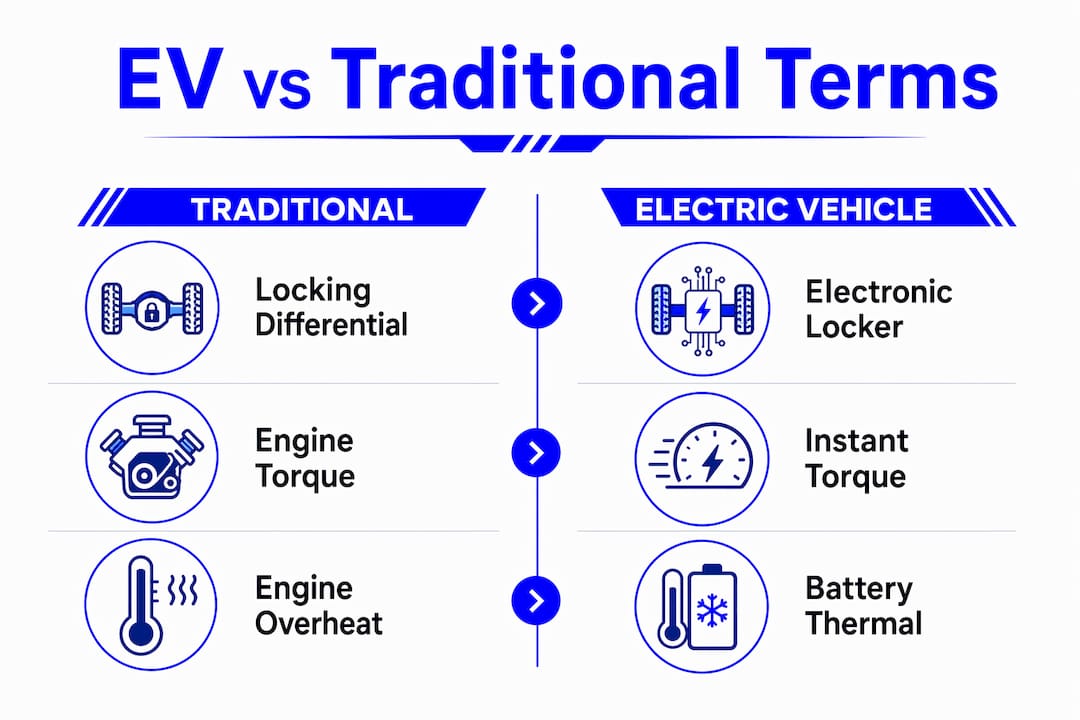
Some classic off-road terms carry over unchanged. Others have been replaced or redefined by electric drivetrain architecture.
| Term | Traditional ICE meaning | EV equivalent or difference |
|---|---|---|
| Locking differential | Mechanical or air-actuated locker | Electronic locker; same function, instant engagement |
| Torque delivery | Engine torque through transmission | Instant full torque from motor; no rev range needed |
| Engine cooling | Radiator and coolant for combustion engine | Battery thermal management system; same goal, different hardware |
| Fuel range | Miles per tank of gasoline | kWh capacity and SoC; range drops faster off-road |
| Refueling | Gas station, 5 minutes | DCFC station, 20 to 40 minutes; far less available off-road |
| Transfer case | Mechanical high/low range selector | Electronic crawl control; software-defined gear reduction |
The most significant conceptual shift is torque delivery. A gas engine produces peak torque only within a specific RPM band, which is why low-range gearing exists. An electric motor delivers maximum torque from zero RPM. This eliminates the need for a traditional transfer case but creates new vocabulary around electronic crawl modes and torque maps. When someone says an EV has “adjustable crawl control,” they mean software is limiting motor output to simulate low-range gearing, not a mechanical system engaging.
Thermal language also shifts. Gas riders worry about engine overheating. EV riders worry about battery thermal management. The underlying concern is the same: heat destroys performance and hardware. The systems managing that heat are completely different, which is why the terminology diverges.
Key takeaways
Mastering off-road electric vehicle terminology requires understanding both the electric drivetrain vocabulary and the classic off-road mechanical terms, because modern EVs like the Rivian R1T and GMC Hummer EV operate at the intersection of both.
| Point | Details |
|---|---|
| Locking differentials | Electronic lockers engage instantly and solve 80 to 90% of off-road traction problems. |
| Torque vectoring types | Multi-motor, e-LSD, and brake-based systems each offer different levels of off-road control. |
| BMS and thermal management | The BMS protects battery health; keep pack temps between 15 and 45°C for safe off-road use. |
| Battery preconditioning | Always precondition before fast charging after trail use to reduce time and thermal stress. |
| EV vs ICE terminology | Electric torque, crawl control, and DCFC replace engine torque curves, transfer cases, and gas refueling. |
Why terminology is the first upgrade you should make
Here is what I have learned from years of working with electric off-road builds at Revlinemods: riders who understand the vocabulary make better decisions at every stage. They ask the right questions when buying parts, they diagnose problems faster, and they communicate clearly with other builders in the community.
The blending of EV and off-road jargon is not just a curiosity. It is a practical skill. When a customer calls asking why their Surron is cutting power on steep climbs, the answer almost always lives in BMS thermal limits or SoC thresholds. If they do not know those terms, the conversation takes three times as long and the fix takes longer too. When someone asks about upgrading their suspension for better articulation, knowing whether they mean independent travel or axle flex changes the entire parts recommendation.
My honest observation is that the terminology is evolving faster than most guides acknowledge. Terms like “regenerative vectoring” and “electronic crawl map” did not exist in mainstream off-road conversation five years ago. They are standard now. The riders who stay current with the vocabulary stay current with the technology. That is not a coincidence.
If you are new to this space, start with the drivetrain and battery terms. Those two domains cover 80% of what you will encounter on the trail and in the shop. The suspension vocabulary will follow naturally once you have the electrical foundation.
— Revline
Upgrade your off-road EV with parts built for the trail
Understanding the terminology is step one. Putting that knowledge into hardware is step two. Revlinemods stocks specialized components built specifically for electric off-road vehicles, including Surron, Talaria, and 79Bike platforms.

The Surron/79Bike chrome motor cover protects one of the most exposed components on your electric trail bike, the motor, against rock strikes, mud, and debris. The 17" OEM supermoto wheelset improves handling and stability on mixed terrain. For riders who want to add both protection and style, the Motocutz front plate delivers both. Every part ships fast and is sourced for the specific demands of electric off-road riding.
FAQ
What does BMS mean in off-road EVs?
BMS stands for Battery Management System. It monitors voltage, current, and temperature, balances cells, and disconnects the pack when safety limits are exceeded to protect battery health during demanding off-road use.
What is torque vectoring in an electric off-road vehicle?
Torque vectoring distributes power between individual wheels to improve traction and cornering. In EVs, multi-motor systems provide the most precise control, enabling maneuvers like tank turns that mechanical differentials cannot perform.
How does ground clearance affect off-road EV performance?
Ground clearance is the distance between the vehicle’s lowest point and the ground. Higher clearance, such as the GMC Hummer EV’s 16 inches, allows the vehicle to clear larger obstacles without damage to the battery enclosure or drivetrain.
Why is battery preconditioning important before charging off-road?
Preconditioning brings the battery to its optimal temperature range before fast charging, which reduces charging time and prevents heat-related power limits. After a hard trail session, skipping this step can significantly slow your DCFC session.
What is one-pedal driving and when should you use it off-road?
One-pedal driving is an aggressive regenerative braking mode that slows the vehicle to a stop without using the brake pedal. On steep descents, it provides controlled engine-brake-style deceleration and recovers energy at the same time.