


Surron electric bike: Features, upgrades, and riding potential
Most people who’ve heard of Surron assume it’s just another electric bicycle with some extra punch. That assumption couldn’t be further from the truth. Surron bikes are purpose-built, modular electric motorcycles with a dedicated aftermarket, passionate community, and upgrade potential that rivals gas-powered dirt bikes. Whether you’re a trail rider chasing better suspension, a tinkerer eyeing battery and controller swaps, or a first-time buyer trying to make sense of what this platform even is, this guide covers the real story behind Surron bikes, where they sit in the market, and how to intelligently unlock their full potential.
Table of Contents
- What makes the Surron electric bike unique?
- The Surron upgrade ecosystem: Main paths and options
- Risks, compatibility, and expert tips for high-performance Surrons
- Getting started: Practical steps for the Surron enthusiast
- Why performance isn’t just numbers: What most Surron enthusiasts overlook
- Ready to upgrade your Surron? Essential parts and expert help
- Frequently asked questions
Key Takeaways
| Point | Details |
|---|---|
| Modular design | Surron bikes are built for easy customization with a strong aftermarket. |
| Upgrade wisely | Balance performance aims with reliability by matching batteries, controllers, and motors. |
| Common first mods | Most owners start with throttle, brakes, suspension, and battery enhancements. |
| Community support | The Surron scene offers extensive guides, bundles, and peer advice for new upgrades. |
What makes the Surron electric bike unique?
Surron bikes occupy a category that didn’t exist a decade ago. They’re not e-bikes in the traditional sense, and they’re not full-size electric motorcycles either. They’re lightweight, high-torque, electric off-road machines built from the ground up to be ridden hard and modified freely.
The platform’s secret weapon is its modular frame design. The aluminum frame, mid-mounted motor, and centralized battery pack create a layout that makes swapping components surprisingly accessible compared to traditional gas-powered bikes. The motor performance and efficiency relationship in these bikes is what gives them such a predictable, manageable power delivery that still feels electric-fast when you crack the throttle.
Here’s what sets the Surron platform apart from the crowd:
- Weight to power ratio: The Light Bee X weighs around 110 lbs fully loaded, yet pushes enough torque to wheelie out of a corner with ease
- Modular electrical architecture: The motor, controller, and battery are designed as separable units, making targeted upgrades realistic without full rebuilds
- Dual-use versatility: Riders run the same platform on technical singletrack and urban environments, often within the same week
- Strong community and parts supply: As noted across the Surron enthusiast world, the Sur-Ron platform has a large aftermarket ecosystem, with common performance-upgrade focus areas like suspension, batteries, controllers, and motors
“People are genuinely surprised when they first ride a stock Surron. The instant torque, low center of gravity, and near-silent power delivery feel completely different from any gas or pedal-assist bike they’ve ridden before.”
One area where new owners often underestimate the bike is throttle feel. Stock Surrons have decent response, but riders who install upgraded throttle options quickly notice how much smoother and more precise the power delivery becomes. Similarly, the exposed motor is a common customization point, with motor cover upgrades adding both protection and a sharper visual identity to the build.
The Surron upgrade ecosystem: Main paths and options
Once you ride a Surron for a few weeks, the stock setup starts to reveal its limits. That’s not a criticism; it’s actually a feature. The platform is intentionally built so that enthusiasts can push it further without starting from scratch.
The four primary upgrade categories are suspension, batteries, controllers, and motors. Here’s how they stack up in terms of what they change about the riding experience:
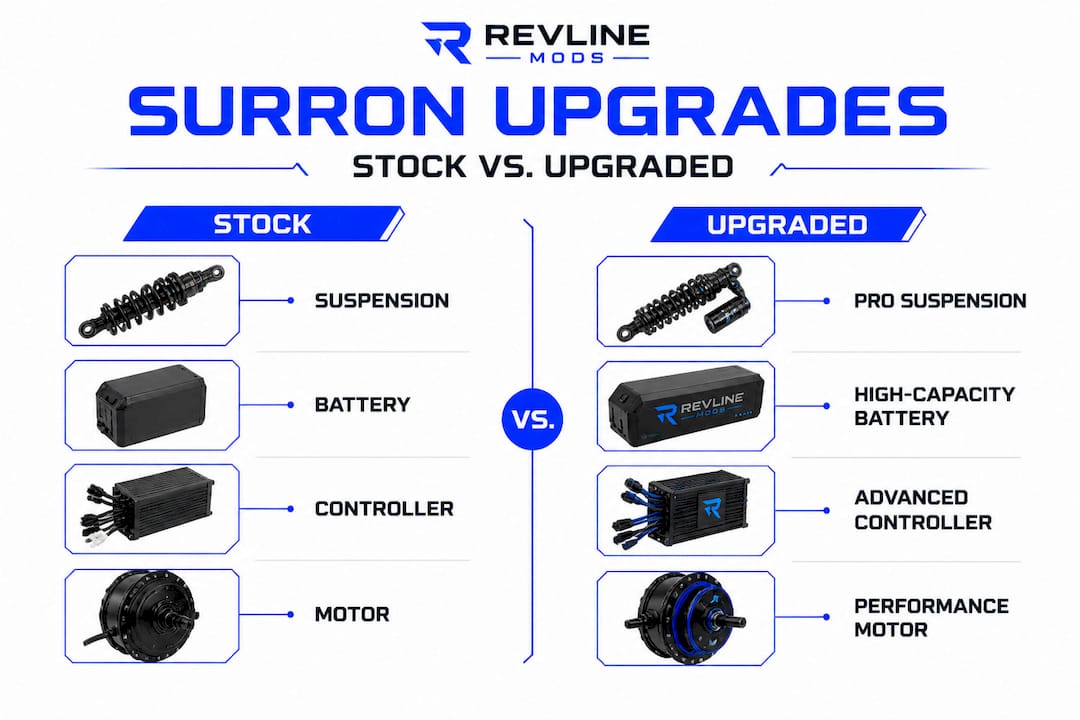
| Upgrade category | Stock performance | Upgraded performance | Difficulty level |
|---|---|---|---|
| Suspension | Basic trail-capable forks and shock | Adjustable damping, improved cornering | Moderate |
| Battery | 60V stock capacity | Higher capacity, longer range, more peak current | Moderate to advanced |
| Controller | Stock amperage limits | Unlocked amperage, programmable maps | Advanced |
| Motor | Mid-power BLDC motor | Higher-winding or rewound motors, more torque | Advanced |
| Brakes | Adequate stock stoppers | Shorter stopping distances, better heat dissipation | Easy to moderate |
Stage-style upgrade bundles, popularized by shops like REV Rides, simplify this process considerably. Stage-style performance bundles focus on improving handling, stopping, and drivetrain performance in organized, sequential phases rather than piecemeal guesswork. This approach keeps your total investment logical and avoids creating mismatches between components.
A practical upgrade order looks like this:
- Brakes first. A faster bike that can’t stop well is genuinely dangerous. Start with brake upgrade options rated for the power output you’re planning to reach, not just your current stock setup
- Suspension second. Better damping transforms confidence on technical terrain more dramatically than most riders expect
- Battery and controller together. These two components need to be matched carefully, so upgrading them as a pair reduces compatibility headaches
- Motor last, if at all. Most riders find that optimizing the battery, controller, and suspension delivers all the performance they actually use on trail or track
Pro Tip: Before buying any electrical upgrade, write down your specific model and year. Surron has released multiple variants including the Light Bee, Light Bee X, Storm Bee, and Ultra Bee, and parts are often not cross-compatible. A controller tuned for one model’s motor winding can underperform or damage components on another.
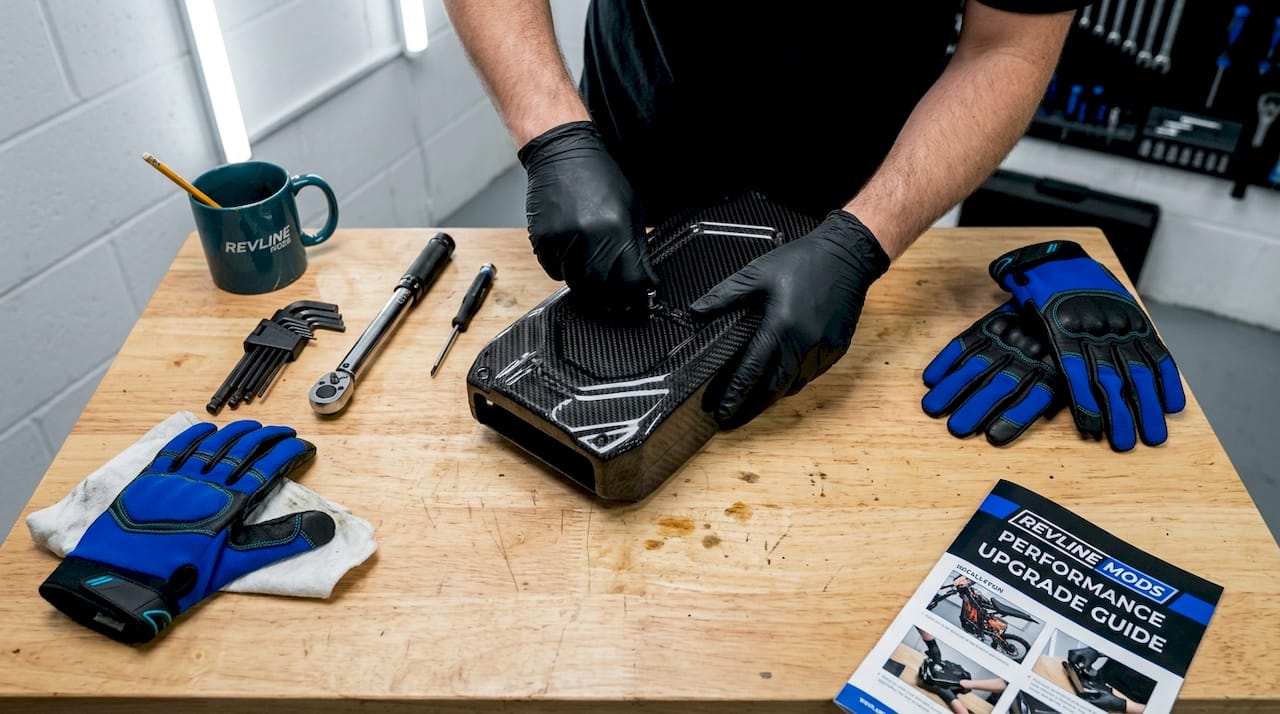
The carbon fiber battery case is a good early upgrade that people often overlook. Beyond the aesthetics, a quality battery cover protects against rocks, debris, and moisture ingress, all of which become more relevant when you start pushing harder on technical trails.
Risks, compatibility, and expert tips for high-performance Surrons
High-performance upgrades on electric bikes carry risks that differ from gas-powered machines. You’re not just dealing with mechanical stress; you’re also managing heat, electrical load, and electronics compatibility across every component simultaneously.
The central risk is thermal overload. When you increase voltage or current through the system, heat generation scales up significantly. Motor windings, controller MOSFETs, and battery cells all have thermal limits, and pushing more current and voltage increases heat load in ways that standard air cooling can’t always manage. This is especially relevant if you’re combining a battery upgrade with a controller upgrade without also addressing motor cooling.
Here’s a breakdown of the most common pitfalls riders encounter:
| Risk area | What causes it | How to avoid it |
|---|---|---|
| Motor overheating | Running high current without adequate cooling | Match controller limits to motor specs, add heat sinking |
| Controller failure | Mismatched voltage ratings | Always verify controller max voltage before pairing with new battery |
| Battery degradation | Sustained high-discharge without BMS protection | Use quality packs with proper BMS, avoid max discharge repeatedly |
| Frame stress | Aggressive riding on stock hardware | Reinforce with hardware durability upgrades |
Compatibility research matters more with these builds than almost anything else. A controller that’s technically rated for the right voltage can still underperform if its amperage limits don’t align with your motor’s efficiency curve. The same logic applies to batteries: a higher-capacity pack with a slow BMS will bottleneck a high-discharge controller and cause both components to run hotter than necessary.
Pro Tip: When researching upgrades, use the community forums and build logs as your primary filter before any spec sheet. Riders who have already run specific component combinations will tell you exactly what works, what runs hot, and what fails after 50 hours. That real-world feedback is worth far more than manufacturer claims alone.
One area that’s easy to overlook during aggressive builds is fastener integrity. High-vibration electric bikes, especially when ridden on rough terrain, generate stress on frame bolts and subframe mounting points over time. Proper e-bike upgrade selection includes thinking about structural hardware, not just electrical components.
Also worth noting: most Surron dealer warranties are voided by major electrical modifications. Before you open the controller or modify the battery management system, have a clear understanding of what your warranty covers and what it doesn’t. Many experienced riders accept this trade-off knowingly, but it should be a conscious decision, not an oversight.
Getting started: Practical steps for the Surron enthusiast
If you’re new to the platform or about to make your first serious upgrade, a structured approach saves money, time, and frustration. The temptation to jump straight into high-wattage electrical mods is real, but the riders who get the most out of their builds start with a clear riding identity.
Step one: Define your primary riding environment. Ask yourself honestly where you’ll spend 80% of your time.
- Trail and enduro riders benefit most from suspension, brake, and frame protection upgrades first
- Track and supermoto riders prioritize tires, suspension setup, and then controller tuning for sharper throttle response
- Urban and commuter riders care more about battery range, lighting, and reliability than outright power
Step two: Plan your upgrade sequence logically. A good rule is safety upgrades first, performance second, and aesthetics third. That means brakes and frame protection before you touch the electrical system.
Step three: Set a realistic budget that includes supporting components. Many riders budget for a new controller and forget that a proper install often requires updated wiring harnesses, connectors, and sometimes a new battery pack to match. Stage-style bundles from established shops exist precisely to solve this problem by bundling the essential supporting components into one kit.
A good starting build for most trail riders involves upgraded brakes, improved suspension at both ends, frame guards, and a quality throttle. From there, battery and controller decisions become much more informed because you’ve spent real time understanding how the stock setup feels and exactly where its limits are.
Your budget planning should also include:
- Specialty tools if you’re doing electrical work yourself
- Spare connectors and heat-shrink tubing for any wiring modifications
- A quality temperature monitoring setup if you’re pushing the electrical system hard
- Contingency funds for any components that need to be replaced during the learning curve
Why performance isn’t just numbers: What most Surron enthusiasts overlook
Here’s the part most upgrade guides skip. After spending time in this community and working with riders across every skill level and budget range, the pattern is consistent: the builds that deliver the most satisfying riding experiences are rarely the ones chasing the highest wattage or the fastest 0-to-30 time.
The riders who obsess over peak numbers tend to end up with bikes that run hot, require constant maintenance, and feel unpredictable in real-world conditions. The riders who approach upgrades methodically, prioritizing throttle feel, suspension balance, and component matching over headline specs, almost universally report better riding, fewer breakdowns, and more fun per mile.
This isn’t a lecture against big power builds. Those have their place on the track and in competition settings. But for the majority of Surron riders on trail and urban terrain, a well-sorted mid-tier build with responsive throttle upgrade and dialed suspension will outperform a poorly matched high-power setup every single time. Smoothness, predictability, and confidence are performance metrics too, even if they don’t appear on a spec sheet.
The most valuable thing you can do early in your Surron journey is ride someone else’s upgraded bike before committing to a specific build path. Community group rides, demo days, and even local forum meetups let you feel the difference between a suspension-focused build and a power-focused one firsthand. That experience will shape your upgrade decisions better than any specification comparison.
Ready to upgrade your Surron? Essential parts and expert help
You’ve got a clear picture of the platform, the upgrade paths, the risks, and the strategy. Now it’s time to source the right components from people who know the platform inside and out.
At Revline Mods, we stock the parts that Surron riders actually need, from practical protection to high-performance electrical and suspension components. Whether you’re picking up a carbon battery lid for your 79Bike or stepping up to a proper supermoto wheelset for track days, our catalog is built specifically around the Surron, Talaria, and 79Bike platforms. Every part we carry is selected with real-world compatibility in mind, not just spec sheet matching. If you’re not sure where to start or want personalized guidance on building out your specific setup, reach out directly. We help riders at every stage, from first-time buyers to experienced builders looking for that final performance edge.
Frequently asked questions
What is the top speed of a Surron electric bike?
Depending on the model and upgrades installed, Surron bikes reach speeds between 47 and 63 mph, with the Storm Bee sitting at the higher end and the Light Bee variants generally in the lower to mid range on stock settings.
Can I upgrade my Surron for more off-road power?
Yes, the Surron aftermarket ecosystem covers batteries, controllers, motors, and suspension, giving off-road riders substantial room to increase both raw power and terrain capability.
Will modifying my Surron void its warranty?
In most cases, major electrical or mechanical modifications will void the factory warranty, so always verify the terms with your dealer or distributor before making irreversible changes.
Do I need special tools to upgrade my Surron bike?
Basic upgrades like brakes and guards use standard mechanic tools, but advanced electrical mods involving controller replacement or wiring work often benefit from a quality multimeter, proper crimping tools, and heat-shrink equipment.
What are common first upgrades for Surron enthusiasts?
Throttle response, brake performance, suspension, and battery capacity are the most popular starting points, and many shops offer stage-based bundles that package these essentials for improved handling, stopping, and drivetrain output.