


The Real Role of Hardware Upgrades in E-Bikes
Most riders assume their stock e-bike is close to its ceiling. Swap the saddle, maybe add a rack, and call it done. That thinking leaves serious performance on the table. The role of hardware upgrades in e-bikes goes far deeper than aesthetics. A firmware-driven torque boost can push output from 85Nm to 120Nm without touching a single bolt. A tire pressure check costs nothing and can recover 20 to 30 percent of lost range. This guide covers every major upgrade category, from motor and controller to battery and tires, with real numbers and safety guardrails you need to get it right.
Table of Contents
- Key takeaways
- Motor upgrades and their role in improving e-bike torque
- Controller upgrades: the brains behind your power
- Battery upgrades and range enhancement strategies
- Tire pressure and mechanical hardware upgrades
- Regulatory and safety considerations for e-bike upgrades
- My honest take on the most overlooked e-bike upgrades
- Upgrade your e-bike with tested hardware from Revlinemods
- FAQ
Key takeaways
| Point | Details |
|---|---|
| Firmware beats hardware swaps | Motor firmware updates can increase torque and support ratios significantly without physical part replacement. |
| Controller upgrades unlock power | Moving from a 20A to a 30A programmable FOC controller improves hill-climbing and acceleration measurably. |
| Battery upgrades need compatibility checks | Mismatched voltage or wiring can cause system failure or fire; always verify before upgrading. |
| Tire pressure is a free range booster | Riding at 25 PSI instead of 50 PSI can cost you up to 30 percent of your range. |
| Legal compliance depends on programming | Hardware power gains are street legal when controllers are programmed within regulatory speed and power limits. |
Motor upgrades and their role in improving e-bike torque
The motor is where most riders want to start, and for good reason. It is the core of every performance conversation on an e-bike. What many people miss, though, is that the most impactful motor upgrade in 2026 does not require unbolting anything.
Bosch’s Performance Upgrade 2.0 is the clearest example. This over-the-air firmware update pushes the Performance Line CX motor from 85Nm to 120Nm of torque and lifts the support ratio from 400 percent to 600 percent. That is a 41 percent torque increase with no physical parts changed. For riders on compatible motors, this is the highest return upgrade available right now. The catch is generation compatibility: not every older motor supports the update, so checking your motor model is the critical first step.
For those pursuing a full motor swap, the upgrade path depends on your frame’s motor mount standard, the battery voltage your current system runs, and the controller you plan to pair with the new unit. Jumping motor generations without matching the controller and battery can create overheating or premature failure.
Here is what to evaluate before any motor upgrade:
- Motor mount compatibility: Mid-drive and hub motors use different mounting systems and are not interchangeable
- Voltage match: A 48V motor in a 36V system will underperform; a 52V motor in a 48V system can damage your controller
- Heat management: Higher output motors generate more heat; check that your frame has adequate clearance and airflow
- Firmware support: Confirm whether your motor generation supports performance firmware upgrades before buying anything
Pro Tip: Before spending money on a physical motor swap, check whether your existing motor is firmware-upgradeable. The cost difference between a firmware update and a motor replacement can be several hundred dollars.
Controller upgrades: the brains behind your power
The controller is the component most riders overlook, yet it determines how your motor behaves in every condition. Think of it as the throttle brain. It decides how much current flows to the motor, how smoothly power is delivered, and how efficiently your battery is used.
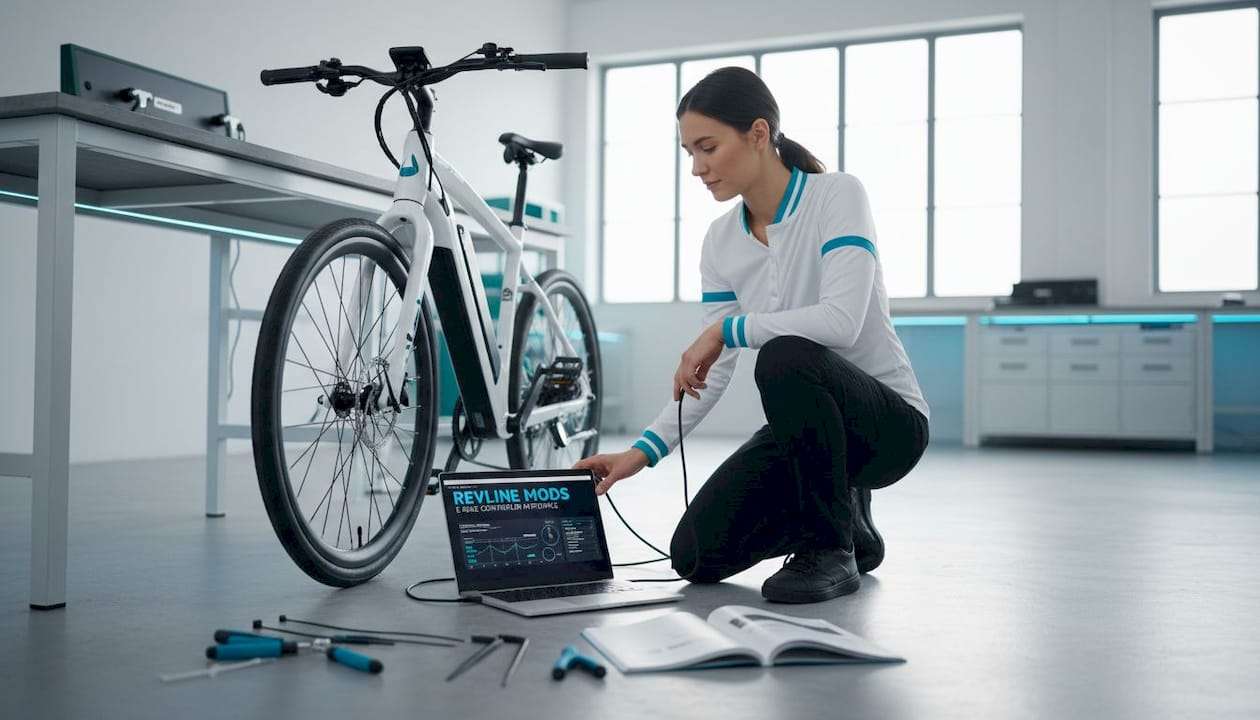
Most stock controllers are basic units rated around 20 amps. Upgrading to a 30A or 35A programmable controller costs between $180 and $400 and delivers noticeably better hill-climbing and off-the-line acceleration. The performance jump is real, but the choice of controller type matters just as much as the current rating.
FOC controllers (Field Oriented Control) represent the current best standard for performance upgrades. An FOC controller calculates optimal current vectors in real time, which means smoother power delivery, less noise, and less heat compared to older trapezoidal controllers. If you have ever felt a sudden lurch when engaging the throttle on a budget bike, a better controller is almost always the fix.
Here is a step-by-step compatibility check before buying a new controller:
- Confirm voltage rating: Your new controller must match your battery’s nominal voltage exactly (36V, 48V, or 52V)
- Check phase and hall sensor wires: Count the motor wire configuration and match it to the controller spec sheet
- Verify connector types: Waterproof XT60 and Anderson connectors are common but not universal; adapters add failure points
- Review max current against motor rating: A controller that exceeds your motor’s rated current will burn out the motor windings over time
- Program speed and power limits: Higher current controllers must be configured to stay within legal output thresholds before you ride on public roads
You can explore more about how controllers shape ride dynamics in this controller performance guide from Revlinemods.
Pro Tip: After installing a new controller, run your first test ride at a conservative power setting. This lets you identify any heat buildup or unexpected behavior before committing to full power.
Battery upgrades and range enhancement strategies
Battery upgrades get more hype than any other e-bike modification, and they genuinely deliver when done correctly. The key metric to understand is watt hours (Wh), not amp hours alone. Wh = voltage × amp hours. A 48V 15Ah battery holds 720Wh. A 48V 20Ah battery holds 960Wh. That difference translates directly into range.
Here is a quick comparison of common upgrade paths:
| Upgrade path | Voltage | Capacity | Expected range gain | Compatibility risk |
|---|---|---|---|---|
| Same voltage, bigger Ah | 48V | 15Ah to 20Ah | 25 to 35% more range | Low, if connectors match |
| Higher voltage system | 48V to 52V | Similar Ah | Better performance + range | High, requires controller review |
| Dual battery setup | Same voltage | Parallel packs | Up to 80% range increase | Medium, requires balancing circuit |
The most common mistake riders make is treating battery upgrades as plug-and-play. Voltage and current mismatches between the battery and controller are the leading cause of controller burnout and, in worst cases, battery fires. Always check that your wiring gauge can handle the increased current load.
On the safety side, look for batteries certified to UL 2849 (US) or EN 50604-1 (EU). These certifications confirm the battery management system (BMS) has been tested for overcharge, short circuit, and thermal runaway protection. Skipping certified packs to save money is one of the most dangerous shortcuts in e-bike upgrades.
Mounting placement also affects handling. A rear-rack-mounted battery shifts weight high and back, which changes steering feel significantly. A downtube or integrated frame mount keeps center of gravity lower and ride dynamics closer to stock.
Tire pressure and mechanical hardware upgrades
This section gets the least attention, yet it is often where the biggest free gains live. Tire pressure at 25 PSI versus 50 PSI can cost you 20 to 30 percent of your total range. That is range you are losing before you even consider battery upgrades. Underinflated tires force the motor to draw more current to maintain the same speed, generating excess heat and degrading battery life faster.
Think of tire pressure as a tuning knob for your e-bike. Lower pressure increases contact patch and grip for rough terrain. Higher pressure cuts rolling resistance for pavement efficiency. Neither extreme is always right. The correct setting depends on your weight, load, and the surface you are riding.
Beyond tires, these mechanical hardware upgrades deliver real improvements:
- Suspension upgrades: Swapping a stock coil fork for an air-sprung unit reduces unsprung weight and lets you tune rebound to your terrain, which directly improves control and reduces rider fatigue
- Brake system upgrades: Hydraulic disc brakes over mechanical ones provide more consistent stopping power with less hand fatigue, critical when carrying extra battery weight
- Saddle and seatpost: A quality dropper post or ergonomic saddle changes long-ride comfort dramatically and costs far less than electrical component upgrades
- Drivetrain components: Chains, cassettes, and chainrings wear faster on e-bikes due to higher torque loads; upgrading to a higher-grade chain reduces drivetrain slippage and energy loss
Pro Tip: Check your tire pressure before every ride, not just when a tire looks low. Even a properly inflated tire can lose 2 to 4 PSI overnight in cold weather, and that small drop compounds into real range loss over a week of commuting.
Regulatory and safety considerations for e-bike upgrades
Hardware upgrades that push your e-bike beyond legal limits create more problems than they solve. In most markets, the legal standard caps continuous motor output at 250W and speed assist at 25 km/h (15.5 mph). Exceeding these thresholds by programming your controller to higher outputs technically reclassifies your bike as a moped or motorcycle, which requires registration, insurance, and a license.
The good news is that powerful hardware can remain street legal when the controller is programmed correctly. A 35A controller in a 48V system is capable of far more than legal limits, but with proper speed cutoffs configured, it stays compliant while still improving low-speed torque and hill performance.
Key safety checks before riding an upgraded bike:
- Inspect all wire connections after any electrical upgrade; loose connections under load cause arcing and heat
- Never mix battery chemistries (LiFePO4 and Li-ion have different charge profiles)
- Use the charger that matches your battery’s BMS specifications
- Consult your motor and frame manufacturer’s manual for weight and power limits
“The most dangerous upgrade is the one done in a hurry. Take time to verify every electrical connection before your first post-upgrade ride.”
For a deeper look at how modification choices intersect with legal limits, the e-bike hardware modification guide at Revlinemods covers compliance in practical terms.
My honest take on the most overlooked e-bike upgrades
I have seen a lot of riders invest in expensive motor swaps when a firmware update would have delivered more torque for a fraction of the cost. That pattern repeats constantly in our community. The upgrades with the best return are often the unglamorous ones.
Tire pressure tuning gets almost no attention, but I have watched riders recover a third of their stated range just by pumping their tires correctly. That is not a small gain. That is the equivalent of adding a substantial portion of battery capacity, for free.
The battery-controller mismatch issue is the one that worries me most. I have seen setups where someone bolted in a higher-voltage pack without upgrading the controller, and the result was a fried controller within two rides. It is not just a financial loss. It is a safety risk. The compatibility verification steps that feel tedious are actually the most important part of any battery upgrade.
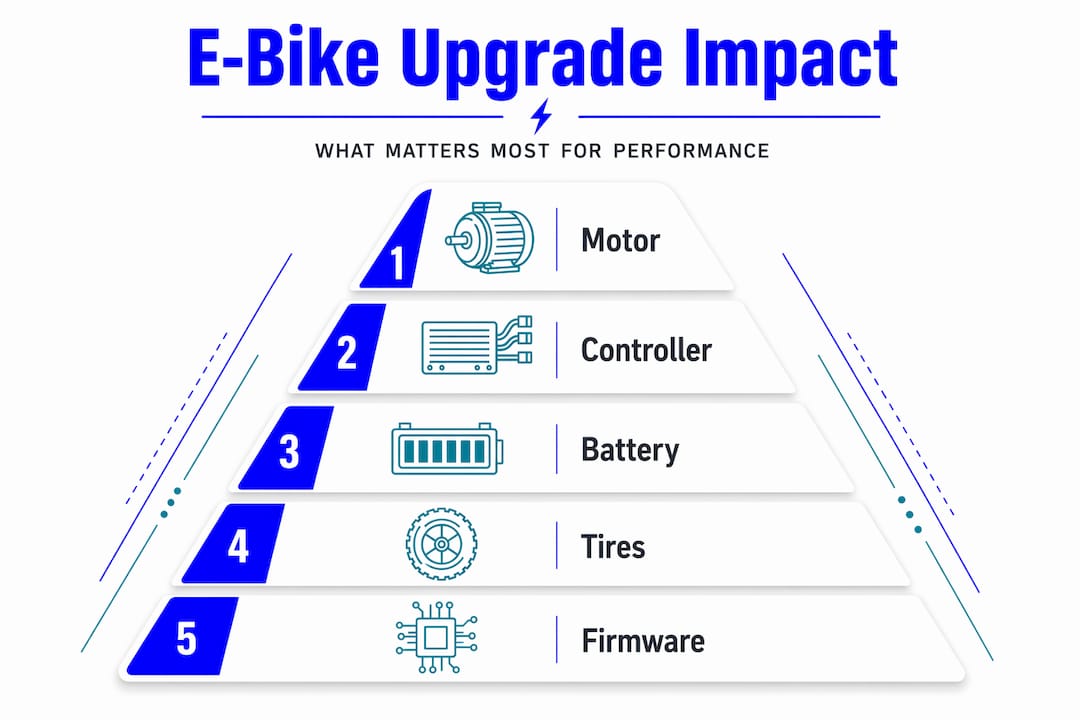
My honest advice: start with the upgrades that cost the least and deliver the most, which means firmware first, tire pressure second, and controller before battery. Physical motor swaps and high-voltage battery systems are legitimate performance upgrades, but they require a systems mindset. One mismatched component can undermine every other upgrade you have made.
— Revline
Upgrade your e-bike with tested hardware from Revlinemods

If you are ready to go beyond firmware and start building out your ride with quality physical hardware, Revlinemods carries a focused selection of performance and protective parts built for serious electric off-road and street riders. The Upgraded Surron Throttle gives you sharper throttle response and more precise control compared to stock, a direct improvement to how your motor upgrade actually feels in your hand. For riders who depend on clean stopping power at higher speeds, the ULTIMATE Ultra Bee Brake Kit is a high-priority upgrade that matches your bike’s increased performance with the braking hardware to back it up. Revlinemods also offers protective components like the Carbon Fiber Surron Battery Cover to guard your upgraded battery from trail debris. Every product in the catalog is selected for compatibility and performance with Surron, Talaria, and 79Bike platforms.
FAQ
What is the biggest impact of hardware upgrades on e-bikes?
Motor and controller upgrades deliver the most measurable performance gains, including higher torque, faster acceleration, and better hill-climbing. Firmware updates like Bosch’s 2026 Performance Upgrade 2.0 can increase torque from 85Nm to 120Nm without any physical part replacement.
How much does a controller upgrade cost for an e-bike?
Upgrading from a standard 20A controller to a 30A or 35A programmable controller typically costs between $180 and $400, and the performance improvement in acceleration and hill-climbing is noticeable from the first ride.
Can hardware upgrades make an e-bike illegal?
Yes, if the controller is programmed beyond legal speed or power limits. However, powerful hardware remains street legal when configured to stay within the 250W continuous and 25 km/h assist cutoff thresholds required in most markets.
Does tire pressure really affect e-bike range?
Significantly. Riding with tire pressure at 25 PSI instead of the recommended 50 PSI can reduce your range by 20 to 30 percent due to higher rolling resistance and increased motor current draw.
What certifications should I look for in an upgraded e-bike battery?
Look for UL 2849 certification in the US or EN 50604-1 in the EU. These standards confirm the battery management system has been tested for overcharge protection, short circuit defense, and thermal runaway prevention.