


The Real Role of Suspension in Electric Bikes
Most riders assume suspension is there to smooth out bumps and make the ride more comfortable. That framing undersells what suspension actually does. The role of suspension in electric bikes extends to tire traction, rider fatigue, component protection, and outright safety on technical terrain. For e-bikes specifically, the added weight of batteries and motors and the instant torque delivery create demands that standard suspension theory doesn’t fully address. This article breaks down how suspension systems function, what happens when they’re poorly tuned, and how to match your setup to the riding you actually do.
Table of Contents
- Key Takeaways
- The role of suspension in electric bikes goes beyond comfort
- Types of suspension systems for e-bikes
- How suspension actually works: spring, damping, and tuning
- Matching suspension to your riding style
- My take on where most riders go wrong
- Upgrade your ride with the right parts
- FAQ
Key Takeaways
| Point | Details |
|---|---|
| Suspension protects more than comfort | It maintains tire contact, reduces fatigue, and shields electronics from impact damage. |
| E-bikes need specialized tuning | Heavier weight and instant torque require different damping and sag settings than standard bikes. |
| Suspension type should match terrain | Hardtails suit commuting and light trails; full suspension pays off on technical or rough ground. |
| Sag setup is non-negotiable | Targeting 20 to 30 percent sag is the starting point for balanced traction and control. |
| More travel isn’t always better | Matching suspension travel to your terrain avoids unnecessary weight and efficiency losses. |
The role of suspension in electric bikes goes beyond comfort
The industry term for what suspension does is “wheel compliance.” It keeps your tire in contact with irregular surfaces instead of skipping or bouncing off them. Suspension absorbs shocks and vibrations to reduce fatigue and improve manageability on rough terrain, but the deeper function is traction management.
When your front tire loses contact with the ground, you lose steering input. When the rear loses contact, you lose drive and braking control. On a standard pedal bike, this is a real concern. On an electric bike with instant motor torque, it can throw a rider off balance in a fraction of a second. That’s why suspension system benefits on e-bikes go far beyond rider comfort.
There’s also the component protection angle, which rarely gets enough attention. Every hard impact that travels through the frame also travels through the battery pack, motor controller, and wiring harness. Over time, repeated shock loading degrades connections and shortens component lifespan. A well-set suspension system is essentially insurance for your drivetrain electronics.
Here’s what a properly functioning suspension system is doing on every ride:
- Absorbing trail impacts before they reach your hands, wrists, and spine
- Keeping tires planted for consistent grip during braking and cornering
- Dampening vibrations that cause cumulative fatigue over multi-hour rides
- Protecting the battery, controller, and frame connections from shock loading
- Maintaining bike composure on rough terrain so you stay in control
“Suspension affects safety and handling by maintaining bike composure and reducing rider fatigue, which enhances confidence and control on rough trails.” — Electric Bike Suspension Overview 2026
The electric bike comfort angle is real, but it’s a downstream benefit of all the mechanical work happening underneath you. Prioritizing it as the only reason for good suspension leaves riders unprepared for what bad suspension actually costs them.
Types of suspension systems for e-bikes
Understanding your options means understanding the trade-offs. Not every rider needs the same setup, and the three main configurations serve genuinely different purposes.
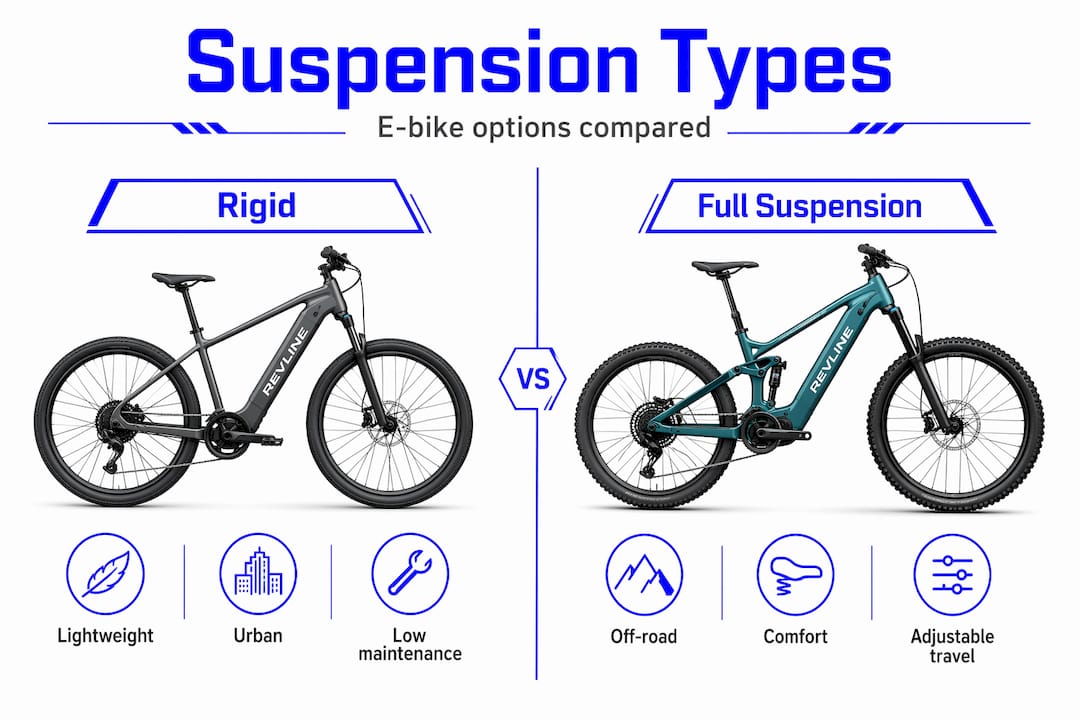
Hardtail (front suspension only) is the most common starting point for e-bikes. A front suspension fork typically offers 80 to 120 mm of travel on trail bikes and 100 to 140 mm on more aggressive setups. The rear triangle is rigid. Hardtails are lighter, mechanically simpler, and more efficient for pedaling because no energy is lost to rear suspension movement. They work well for commuting, gravel, and moderate trails where rear wheel inputs are manageable.
Full suspension (front and rear) adds a rear shock absorber to the equation. Dual suspension improves control and comfort especially on technical terrain because the rear shock reduces vibrations and keeps the tire planted. The trade-off is weight, cost, and an additional service point. For off-road bikes and e-MTBs tackling serious terrain, it’s the right call.
Rigid (no suspension) appears mostly on urban commuter e-bikes with fat tires. The tires themselves absorb some vibration, and the terrain doesn’t demand more. Rigid setups are light and maintenance-free but inappropriate for anything beyond smooth pavement or hard-packed gravel.
| Setup | Best terrain | Travel range | Key trade-off |
|---|---|---|---|
| Rigid | Pavement, smooth gravel | None | Zero maintenance, zero compliance |
| Hardtail | Light trails, commuting | 80 to 140 mm | Efficient but harsh on rough terrain |
| Full suspension | Technical trails, off-road | 130 to 170 mm | More control, more weight and cost |
Typical suspension travel for full-suspension e-MTBs sits around 150 to 160 mm, with longer travel improving rough terrain capability at the cost of pedaling efficiency on smooth ground. The role of suspension in off-road bikes follows the same logic: match travel to the severity of terrain, not to what looks most capable on a spec sheet.
For riders exploring the types of off-road vehicle mods that make the biggest real-world difference, upgrading from rigid to a quality front fork is often the single change that transforms trail riding.
How suspension actually works: spring, damping, and tuning
Most riders understand that suspension compresses when you hit a bump. Fewer understand what stops it from bouncing back uncontrollably afterward. That’s the damper’s job, and it’s the most misunderstood part of the system.
The spring (either coil or air) stores energy during compression. The damper converts that energy into heat through hydraulic fluid, controlling how fast the suspension returns to its original position. Without hydraulic damping, forks behave like pogo sticks, and unpredictable suspension movement destroys traction and rider confidence.
On electric bikes, this matters more than on standard bikes for two reasons. First, the extra weight of the battery and motor loads the suspension differently. Second, instant torque during acceleration compresses the rear suspension aggressively, demanding faster and more precise damping response. E-bike suspension tuning differs from standard mountain bikes due to this torque dynamic, requiring specially tuned valving and damping to handle the different weight distribution.
Here’s how to approach suspension tuning on an e-bike:
- Set sag first. Target 20 to 30 percent sag by adjusting air pressure or spring preload while sitting in your normal riding position. Sag is the amount the suspension compresses under your weight alone.
- Adjust rebound damping. Start slow (more damping) and speed it up until the wheel returns to the ground quickly without bouncing.
- Dial compression damping. Add compression damping if the suspension dives too hard under braking or during fast hits. Too much compression makes the ride harsh.
- Test and iterate. Ride a familiar section before and after each change. One adjustment at a time.
Pro Tip: Avoid the common mistake of pumping more air pressure into your fork to compensate for the e-bike’s extra weight. Overcorrecting with spring pressure kills small-bump sensitivity and makes the ride harsher overall. Better damping tuning solves the same problem without sacrificing feel.
The impact of suspension on ride quality is most visible in this tuning phase. Two bikes with identical forks can feel completely different based on how they’re set up.
Matching suspension to your riding style
Getting suspension right isn’t just about specs. It’s about honest self-assessment of where you ride and what you want from the bike.
Riders who spend most of their time on pavement, bike paths, and occasional gravel don’t need full suspension. A well-tuned hardtail or even a quality rigid fork with volume spacers adjusted for their weight will cover the job efficiently. Full suspension adds 2 to 4 pounds to most e-MTBs, and on flat or smooth terrain, that extra weight degrades pedaling efficiency and eats into range.
Where full suspension earns its place:
- Sustained technical descents with repeated square-edged hits
- Loose or rocky surfaces where rear wheel traction is constantly challenged
- Long rides where cumulative fatigue from a rigid rear would end the day early
- Riders who ride faster than the terrain comfortably allows on a hardtail
Full suspension offers better comfort and traction but adds weight and maintenance complexity. Hardtails are more efficient and simpler but less forgiving on rough terrain. Neither is universally better. The honest answer depends on your trails, your pace, and how much you want to maintain.
Battery range is also part of this calculation. Rear suspension flexes and absorbs energy during pedaling on anything but the smoothest ground. Efficient suspension design (with anti-squat geometry) minimizes this, but it’s never zero. Riders who prioritize range over trail capability should factor efficiency into their suspension choice.
Maintenance is the final consideration most buyers skip. A rear shock needs periodic service: usually a lower leg service every 50 hours and a full rebuild every 100 to 200 hours of hard riding. Add that cost and time to your ownership calculation before buying full suspension.
My take on where most riders go wrong
I’ve spent a lot of time working with electric bikes across different conditions, and one pattern keeps repeating: riders treat suspension as a set-and-forget component. They buy the bike, ride it as-delivered, and never touch the fork or shock settings. For a stock bike tuned to an average 165-pound rider, that’s a real problem if you weigh 140 or 200 pounds.
In my experience, the single biggest improvement most e-bike riders can make has nothing to do with motor power or battery capacity. It’s setting sag correctly and spending 20 minutes dialing in rebound. I’ve watched riders go from struggling on moderate trails to riding confidently on the same terrain, with zero hardware changes, just proper suspension setup.
The weight and torque of e-bikes have genuinely changed what suspension needs to do. I’ve seen forks that work beautifully on a 28-pound trail bike feel completely overwhelmed on a 50-pound e-MTB because the valving wasn’t designed for that load. That’s not a rider skill issue. It’s a spec mismatch.
My honest view is that suspension tuning deserves at least as much attention as any motor or battery upgrade. A bike that stays planted and composed makes you faster, safer, and less tired than a more powerful bike that squirms through corners. If you’re researching hardware upgrades for e-bikes, put suspension setup at the top of the list before anything else.
— Revline
Upgrade your ride with the right parts

Better suspension setup is only part of the equation. When your brakes can’t match the control your suspension is giving you, you’re leaving safety on the table. At Revlinemods, we stock high-performance brake upgrades purpose-built for electric bikes, including the Ultra Bee brakes for Surron, Eride, and 79Bike that deliver consistent, reliable stopping power to match your improved handling. If you’re running a broader e-bike platform, the Ultra Bee brake system fits Macfox, Super73, Ridstar, and more. Pairing quality suspension tuning with upgraded brakes is the most complete performance gain you can make without touching the motor. Explore the full catalog at Revlinemods to find the parts that match your build.
FAQ
What does suspension actually do on an electric bike?
Suspension absorbs trail and road impacts to keep tires in contact with the ground, protect electronics from shock damage, and reduce rider fatigue. On e-bikes, it also manages the added load from battery and motor weight during acceleration and braking.
How much sag should I set on my e-bike suspension?
Target 20 to 30 percent sag on both front and rear suspension, measured while sitting in your normal riding position. This balances traction, pedaling efficiency, and control across varied terrain.
Is full suspension worth it on an electric bike?
Full suspension makes sense for technical off-road riding, sustained descents, and rough terrain where rear wheel traction is critical. For commuting and light trails, a hardtail is lighter, cheaper, and more efficient.
Why does e-bike suspension need special tuning?
Electric bikes are heavier and deliver instant torque, which creates different compression and rebound demands than standard bikes. Stock suspension settings tuned for average riders often need adjustment for e-bike weight and dynamics.
Can bad suspension damage my electric bike’s components?
Yes. Repeated hard impacts transfer shock loads through the frame to the battery, controller, and wiring. Over time, this degrades connections and shortens the lifespan of sensitive electronics.