


Top performance benefits of custom electric wheels
Choosing wheels for a high-torque electric motorcycle isn’t the same decision it is for a gas-powered bike. Electric motors deliver power instantly, without the gradual buildup you get from an internal combustion engine, and that changes everything about how your wheels need to perform. The wrong setup can blunt acceleration, create handling problems, or worse, lead to spoke failure under hard torque loads. Custom electric wheels give you the control to match your setup precisely to your riding style, motor output, and aesthetic goals. This guide breaks down what actually matters, from materials to lacing patterns to size selection, so you make the right call the first time.
Table of Contents
- Core performance benefits of custom electric wheels
- Customization options: Matching wheels to your ride and style
- Material matters: Carbon, forged, and alloy wheel advantages
- Torque and safety: What enthusiasts must know
- A builder’s perspective: What most riders miss about custom electric wheels
- Upgrade your build with Revline Mods
- Frequently asked questions
Key Takeaways
| Point | Details |
|---|---|
| Performance boost | Custom electric wheels enhance acceleration, grip, and power delivery by matching your riding style and motor output. |
| Material impact | Choosing between carbon, forged, and alloy wheels changes both the feel and durability of your electric bike. |
| Essential safety upgrades | Reinforced spokes and expert wheel assembly prevent failures and maximize reliability in high-torque applications. |
| Aesthetic expression | Custom wheels let you personalize your ride with unique sizes, colors, and finishes. |
Core performance benefits of custom electric wheels
With performance as the main motivation, let’s examine how customization options translate to real-world gains.
Custom wheels are not just a visual upgrade. On an electric motorcycle, especially a Surron, Talaria, or 79Bike platform, they directly shape how power gets to the ground. The benefits stack up quickly once you understand what each variable contributes.
The most immediate gain is weight reduction. Rotational mass matters far more than static weight on a motorcycle. Every gram you remove from a wheel has roughly twice the impact on acceleration compared to removing the same gram from the frame. Lighter wheels spin up faster, respond quicker to rider input, and reduce the energy your motor has to work against with every acceleration burst.
Grip and handling are the next big wins. A wheel sized and shaped correctly for your tires creates better contact patch geometry. Whether you’re running slicks for supermoto or aggressive knobby tires for trail riding, the right rim width and diameter keeps the tire profile where it’s designed to be.
Key performance benefits include:
- Faster acceleration through reduced rotational inertia
- More precise steering response on tight trails or track sections
- Better torque transfer from hub motor to rim
- Extended wheel lifespan when built with correct spoke tension
- Visual customization that reflects your riding identity
Customization allows tailoring wheel size, spoke count, lacing patterns, materials, and colors for specific riding styles like supermoto or off-road. This level of precision is something stock wheels simply cannot match, since factory builds prioritize broad compatibility over peak performance.
“For electric motorcycle enthusiasts, custom forged or carbon wheels excel in high-torque applications by minimizing rotational inertia, crucial for instant EV power delivery, but require skilled building to ensure tension consistency.”
Pro Tip: When shopping for custom wheels, ask the builder specifically about spoke tension readings. A wheel with inconsistent tension across spokes will develop wobble and premature fatigue regardless of how premium the materials are.
If you’re looking for a direct upgrade path, the 17" OEM Supermoto Wheelset is a strong starting point for riders wanting factory fitment quality with real performance improvements over baseline stock setups.
Customization options: Matching wheels to your ride and style
Once you know the core performance benefits, it’s time to look at the custom options that make your electric motorcycle unique.
Every variable in a wheel build has a real-world effect. This is not about picking the coolest color first. It’s about building backward from how and where you ride, then letting the aesthetic choices follow.
Wheel diameter is often the first decision. A 14-inch wheel keeps your bike lower to the ground with snappier handling in tight sections. A 17-inch wheel rolls over obstacles more smoothly, maintains speed better on mixed terrain, and is the standard choice for supermoto conversion builds. Going too large sacrifices acceleration feel; going too small can make high-speed stability twitchy.
Spoke count and lacing patterns control how load is distributed around the rim. More spokes mean more contact points, spreading stress more evenly. This matters a lot on electric motors because torque delivery is instantaneous. A 36-spoke wheel laced in a 3-cross pattern handles acceleration forces much better than a 28-spoke radial lace on an aggressive motor setup.
Materials come next, and they are covered in depth in the next section. But at a summary level, aluminum alloy covers most riders, forged aluminum handles harder use and heavier builds, and carbon fiber is the premium choice for maximum weight savings.
Here’s a quick reference table to help match your riding style to your wheel specs:
| Riding Style | Ideal Diameter | Spoke Count | Best Material |
|---|---|---|---|
| Supermoto / Street | 17 inch | 36 spokes | Forged aluminum |
| Trail / Off-road | 14 to 18 inch | 32 to 36 spokes | Alloy or forged |
| Motocross / Racing | 18 to 19 inch | 36 spokes | Carbon or forged |
| Urban Commuting | 16 to 17 inch | 28 to 32 spokes | Alloy |
| Casual / Mixed Use | 17 inch | 28 to 32 spokes | Alloy |
Wheel customization covers spoke count, lacing patterns, materials, and colors in ways that can be tuned specifically to your bike’s motor output and terrain demands.
Color and finish are where personal expression comes in. Anodized aluminum comes in black, gold, blue, red, and more. Powder-coated options are widely available and more durable than paint. If you want your wheels to match your frame, motor cover, or protection gear like the Talaria MX3/4/5 Rear Shock Guard, coordinating colors across your build is completely achievable with today’s custom wheel options.
Pro Tip: Build your wheel spec around your heaviest use case, not your average ride. A wheel that handles your hardest sessions without issue will more than hold up for everything else.
Material matters: Carbon, forged, and alloy wheel advantages
Customizing parameters is half the story. The choice of material is what really changes your riding experience.
Material selection is one of the most consequential decisions in any custom wheel build, and it’s also where a lot of riders either overspend or leave real performance on the table.
Carbon fiber is the performance ceiling. Carbon wheels can weigh 30 to 40 percent less than comparable aluminum options, and that weight reduction directly cuts rotational inertia. On an electric motor that fires with zero lag, less rotational inertia translates into sharper acceleration off the line and faster direction changes mid-corner. The tradeoff is cost and impact resistance. Carbon is stiff and lightweight, but a hard side impact can crack it in ways that aluminum would simply dent and survive.
Forged aluminum is the sweet spot for most serious riders. The forging process aligns the grain structure of the metal, producing a wheel that is significantly stronger than a cast aluminum equivalent at nearly the same weight. Custom forged or carbon wheels excel in high-torque applications by minimizing rotational inertia, but the forged aluminum option gives you durability that’s better suited to rough terrain where rock strikes and hard landings are part of the deal.
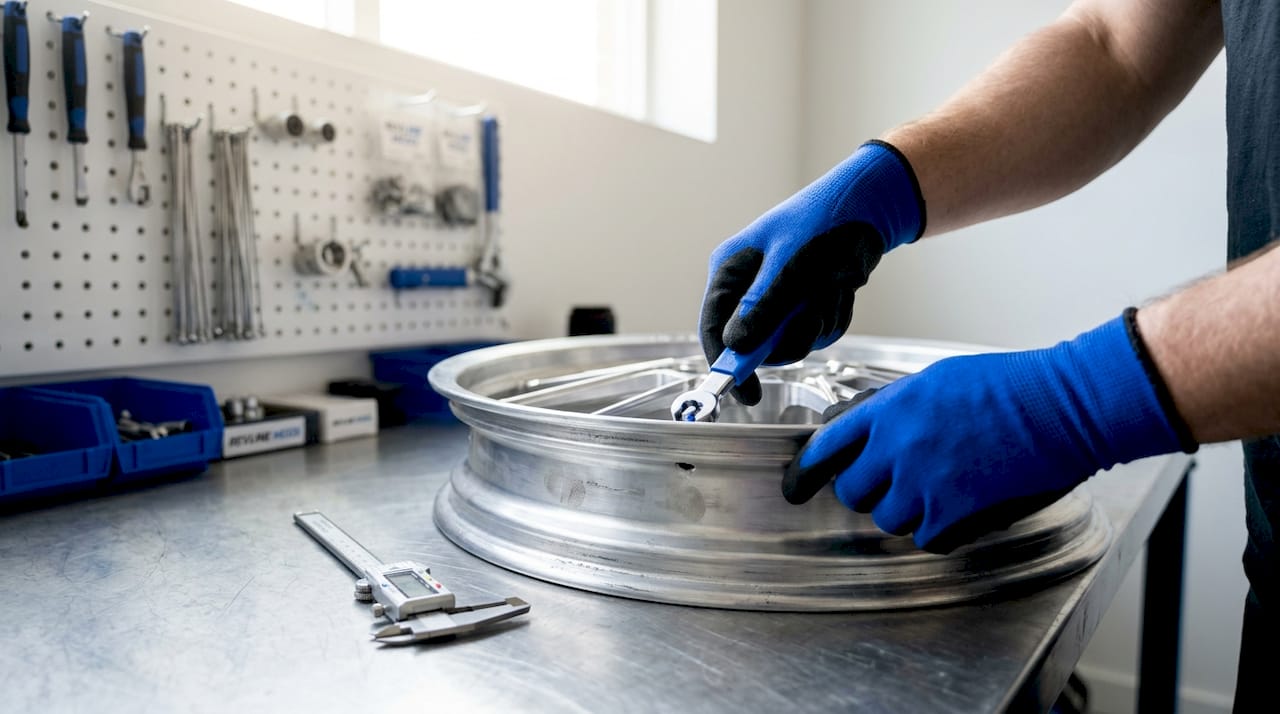
Cast alloy is the budget-friendly option that still outperforms steel in weight. It’s reliable for casual riding, urban commuting, and lighter electric platforms. If you’re not running aggressive motor output and you stick mostly to pavement or smooth dirt, alloy does the job without the premium cost.
Here’s how the three materials compare side by side:
| Material | Weight | Strength | Cost | Best For |
|---|---|---|---|---|
| Carbon fiber | Very low | High (brittle on impact) | High | Racing, performance builds |
| Forged aluminum | Low | Very high | Medium to high | Off-road, supermoto, hard use |
| Cast alloy | Medium | Medium | Low to medium | Commuting, casual riding |
Good wheel care and maintenance tips apply across all materials, but carbon wheels in particular need regular inspection for micro-cracks, especially after any significant impact. Forged and alloy wheels should be checked for spoke tension and rim trueness after hard sessions.
For riders interested in matching their wheel upgrades to other lightweight components, explore carbon fiber rear wheel options and accessories that extend the same weight-saving philosophy across the whole build.
One thing worth emphasizing: no material compensates for a poor build. A carbon wheel that’s improperly tensioned will fail faster than a well-built alloy wheel. Material choice and build quality work together.
Torque and safety: What enthusiasts must know
Getting the right material and fit is essential, but for electric power delivery, build quality and safety considerations can’t be overlooked.
Hub-motor electric motorcycles, which are standard across most Surron, Talaria, and similar platforms, put stress on the wheel in a fundamentally different way than chain-driven or belt-driven setups. The motor sits inside the hub and applies torque directly to the spoke flange. Every hard acceleration sends that force outward through the spokes to the rim. If the spokes aren’t up to that task, failure is not a question of if but when.
Here’s what every rider should check and prioritize before and after custom wheel installation:
- Spoke material and gauge: Use stainless steel spokes with an appropriate gauge for your motor’s output. Thicker gauge spokes handle torque loads better. Do not cut costs here.
- Lacing pattern: A 3-cross or 4-cross lacing pattern is recommended for hub-motor setups. This distributes torque across more of the spoke length, reducing stress concentration at the bend.
- Initial tension check: After installation, have the wheel professionally tensioned and trued before your first ride. Uneven tension creates hot spots that fatigue and break.
- Break-in re-tensioning: New spoke builds settle during the first few rides. Re-check tension after the first 50 to 100 miles of use.
- Ongoing inspection: After any hard crash or extreme session, inspect each spoke individually for looseness or damage before your next ride.
“Custom rims laced to motor hubs must use reinforced spokes (e.g., 3-4 cross) to handle torque without failure.” This isn’t a guideline, it’s a structural requirement for safe operation on high-output electric motors.
Brake performance is closely tied to wheel integrity. A wheel that’s even slightly out of true will cause brake pulsation, reduce stopping power, and wear brake pads unevenly. Pairing a quality custom wheel build with upgraded stopping hardware like brakes for mini motos creates a complete safety system that holds up under hard use.
Safety doesn’t mean slow. It means your build can do exactly what you’re asking of it every single time.
A builder’s perspective: What most riders miss about custom electric wheels
Most riders come into a custom wheel build thinking about weight and color. Both matter, but neither one will save you from the real mistake: skipping professional lacing and tension work.
We’ve seen it more than once. A rider invests in premium carbon rims, quality spokes, and a beautiful finish, then has a buddy do the lacing in a garage without a tensiometer. The wheel looks great for two rides. Then the spokes start going. Then the rim pulls. Then the whole build is a wash, plus the cost of doing it right the second time.
Here’s the uncomfortable truth: the labor on your wheel build is as important as the parts. A skilled builder who uses a tensiometer, checks every individual spoke, and stress relieves the wheel after lacing is worth more to your long-term performance than any single material upgrade. This is not the place to DIY unless you genuinely have the tools, training, and experience.
The second thing most riders miss is thinking about the full system. A lighter wheel with the wrong tire profile for your rims, or a beautifully laced build paired with worn-out bearings, doesn’t get you the gains you’re chasing. When you upgrade to something like a 17-inch supermoto wheelset, that’s the moment to also look at your brakes, bearings, and tire selection as a complete package.
Budget for quality assembly the same way you budget for quality parts. The riders who get the most out of their custom builds are the ones who treat skilled labor as a line item, not an afterthought.
Upgrade your build with Revline Mods
You now know what separates a performance-first wheel build from a weekend project that looks good but disappoints on the trail. Whether your priority is lighter rotational mass, a sharper aesthetic, or a setup that can genuinely handle the torque of your electric motor, the right parts make all the difference.

At Revline Mods, we stock components built specifically for the Surron, Talaria, 79Bike, and related electric platform communities. From custom supermoto wheels that drop right into your build to carbon fiber accessories that cut weight across the whole bike, every product is selected for real riders who expect real performance. Don’t forget that complete builds also need properly matched brake upgrades to handle the extra performance your new wheels unlock. Browse the full catalog and find the upgrade that fits your ride.
Frequently asked questions
Are custom electric wheels worth the investment for everyday riders?
For most riders, yes. Custom wheels tailored to spoke count, lacing, and materials improve both ride quality and longevity when matched to your specific motor output and terrain demands.
Which wheel material is best for electric motorcycles?
Carbon fiber delivers the best weight-to-performance ratio, while forged aluminum is the more practical choice for durability on rough terrain. Custom forged or carbon wheels minimize rotational inertia in ways that directly benefit electric motor applications.
How do custom wheels affect electric motorcycle safety?
Proper build quality is the key safety factor. Custom rims laced to motor hubs require reinforced spokes in a 3-4 cross pattern to prevent failure under the instant torque loads typical of electric motors.
Do custom wheels require more maintenance than stock wheels?
Not if they’re built correctly. Skilled tension consistency in custom builds actually extends wheel lifespan compared to factory-built alternatives, reducing how often you need to true or re-tension.