


Understand torque in electric bikes for better upgrades
Most riders obsess over watt ratings when shopping for an electric bike or planning upgrades, but watts alone don’t explain that gut-punch of acceleration off the line or the confident pull up a steep, loose hillside. That feeling comes from torque, and if you want to make smart customization decisions, torque is the number you need to understand deeply. This article breaks down what torque actually means on an electric bike, how it’s measured and sensed, how it interacts with your drivetrain and wheel setup, and what you need to know before touching your next upgrade.
Table of Contents
- What is torque in electric bikes?
- How e-bike torque sensors work: Understanding pedal-assist
- Gearing, wheels, and real-world torque: Why system matching matters
- Torque benchmarks and real-world measurement: What numbers matter?
- Optimizing torque for upgrades: Practical tips for enthusiasts
- Why torque is misunderstood—and what actually matters for enthusiasts
- Enhancing your torque: Upgrade solutions at Revline Mods
- Frequently asked questions
Key Takeaways
| Point | Details |
|---|---|
| Torque fuels acceleration | More torque means stronger launch and better hill climbing in electric bikes. |
| Sensor systems change pedal feel | Torque-sensing makes assistance smoother and more responsive than cadence-based options. |
| System integration is critical | Matching motor, controller, battery, cooling, and gearing delivers real-world torque gains. |
| Benchmarks vs reality | Manufacturer torque numbers often differ from what riders experience due to testing and settings. |
| Customization goes beyond Nm | Consider current limits, battery sag, and thermal management for meaningful torque upgrades. |
What is torque in electric bikes?
Torque is the fundamental force that makes your electric bike move. Technically, torque on an electric bike is the rotational (twisting) force the motor applies to the drivetrain, typically specified in newton-meters (Nm). Think of it like this: if power (watts) is how long you can keep pushing, torque is how hard you push at any given instant.
This distinction matters enormously for riders. A bike with high torque but moderate wattage will blast off the line and nail steep climbs. A bike with high wattage but modest torque will cruise comfortably at top speed on flat ground but feel sluggish off the mark. For off-road riding, motocross-style acceleration, and urban stop-and-go conditions, torque is king.
Here are the core things torque controls on your electric bike:
- Launch acceleration: The harder your motor twists the drivetrain at zero speed, the faster you accelerate from a standstill.
- Hill climbing: Gravity demands a rotational force greater than what it takes to pull the bike and rider uphill. Torque provides that force.
- Low-speed traction: More torque at low RPM means your wheel maintains grip and push through loose dirt, gravel, or sand.
- Rider feel: Responsive torque delivery makes the bike feel alive and connected; weak torque makes it feel numb.
“Torque dominates the riding experience at the moments that matter most: the launch, the climb, and the moment you need instant response from your machine.”
For context, a typical commuter e-bike might produce 40 to 50 Nm. A performance-oriented electric motorcycle like the Surron or Talaria platforms that many of you are already riding or upgrading can deliver significantly more. Getting familiar with motorcycle terminology around torque, watts, and drivetrain specs is a solid foundation before diving into any serious build.
How e-bike torque sensors work: Understanding pedal-assist
Once you understand what torque is, the next layer is understanding how your bike’s electronics sense and respond to it in real time. E-bike pedal-assist control connects rider effort to motor output. Systems can use torque sensing (measuring how hard you pedal) or cadence sensing (measuring how fast you pedal). These two approaches produce dramatically different riding experiences.
Cadence sensors are simpler and cheaper. They detect whether the cranks are spinning and switch the motor on at a fixed assist level. The result is a somewhat binary feel: motor on, motor off. Torque sensors, by contrast, measure exactly how much force you’re applying through the pedals and tell the controller to match that effort proportionally.
Torque-sensing e-bike motors often rely on strain gauges in the bottom bracket or crank area to infer torque, then the controller modulates motor assistance accordingly for a smoother, more “natural” feel. Here’s a quick comparison:
| Feature | Cadence sensor | Torque sensor |
|---|---|---|
| Sensitivity | Detects rotation only | Measures actual pedal force |
| Assist feel | On/off, slightly abrupt | Smooth, proportional to effort |
| Riding response | Slight delay at start | Immediate, natural |
| Cost | Lower | Higher |
| Best for | Budget builds, casual use | Performance builds, trail riding |
For customization purposes, understanding your sensor type matters because it affects how controller and motor upgrades will perform in practice. A high-torque motor paired with a cadence sensor will still deliver jerky, imprecise assist unless the controller and sensing hardware match its capabilities.
Here’s a step-by-step way to think about how a torque-sensing system works from pedal to wheel:
- You apply force to the pedals. The strain gauge deforms slightly and generates an electrical signal proportional to that force.
- The signal travels to the motor controller. The controller interprets the signal in milliseconds.
- The controller adjusts motor current output. More force from you equals more current and therefore more torque from the motor.
- Motor torque is applied to the drivetrain. The bike accelerates smoothly in response to your input.
- The cycle repeats many times per second. This constant feedback loop is what creates that “natural” feel.
Pro Tip: If you’re planning to modify your controller or motor for higher output, confirm your torque sensor’s rating can handle the increased feedback range. Mismatched components can cause erratic assist behavior or even sensor failure. DIY motorcycle mods work best when the entire system is thought through together.
Gearing, wheels, and real-world torque: Why system matching matters
Understanding torque at the motor is only half the story. The force your wheel actually applies to the ground is the result of how that motor torque flows through your entire drivetrain. Motor torque at the crank does not translate one-to-one into wheel force. Gearing, especially with mid-drive motors, can multiply effective wheel torque significantly.
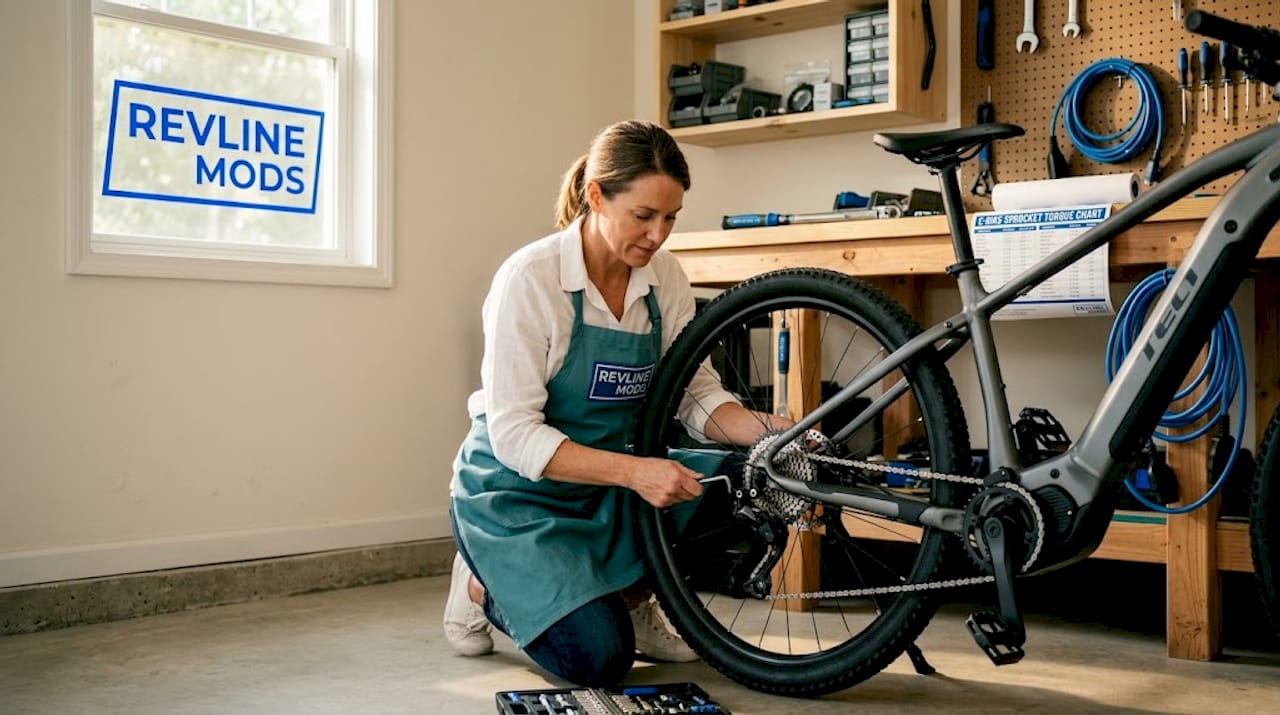
This is why a mid-drive motor rated at 70 Nm can outclimb a hub-drive motor rated at 90 Nm when geared properly. The mid-drive uses the bike’s own gear ratios to multiply torque before it reaches the wheel. A hub-drive bypasses gearing entirely, so you get exactly what the motor outputs and nothing more.
Here’s a comparison of mid-drive versus hub-drive torque delivery to put this in perspective:
| Characteristic | Mid-drive motor | Hub-drive motor |
|---|---|---|
| Gearing multiplication | Yes, uses bike’s gearing | No, direct drive only |
| Hill-climbing efficiency | Very high at low gears | Limited by fixed torque |
| System complexity | Higher | Lower |
| Upgrade flexibility | Strong (gearing + motor) | Mostly motor-only |
| Traction control feel | Nuanced, gear-dependent | Direct, simpler |
For customizers, this means wheel upgrades are not cosmetic decisions alone. Wheel diameter directly affects the torque felt at ground contact. A larger wheel spreads torque over a bigger circumference, reducing the effective force at the contact patch. A smaller, lighter wheel concentrates that force. Custom wheels are one of the most impactful upgrades you can make for real torque delivery and traction response.
Key factors to consider when matching your drivetrain to your torque goals:
- Wheel diameter: Smaller diameter increases effective torque at the ground.
- Gear ratios: Lower gears multiply motor torque for climbing; higher gears reduce torque for speed.
- Tire contact patch: Wider tires spread torque over more surface area, which can improve traction on loose terrain.
- Motor placement: Mid-drive lets you use gearing; hub-drive limits torque to what the motor alone produces.
Pro Tip: Before upgrading your motor, look at your gearing setup first. A simple sprocket swap can deliver a meaningful torque increase at the wheel without touching your motor at all. Check out these off-road enhancement tips for a practical starting point.
Torque benchmarks and real-world measurement: What numbers matter?
Let’s put some real numbers on the table. Major e-bike drive systems are commonly quoted in torque ranges, approximately 40 to 60 Nm for lighter or casual use, 60 to 70 Nm for moderate hills, and 80 Nm or above for steep hills or heavy loads. Performance electric motorcycles and off-road builds push well beyond those numbers.
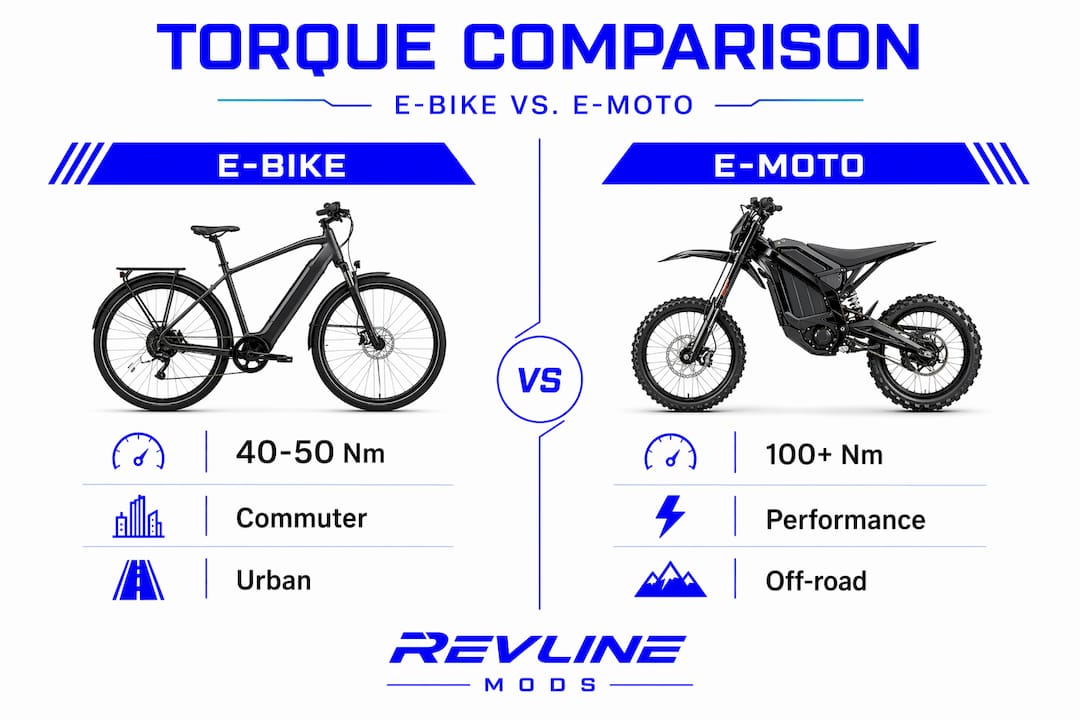
But here’s the uncomfortable truth: manufacturer torque claims may not exactly match measured results depending on test conditions and assist settings. Some independent tests have found significant drops in effective torque output at certain assist levels or under thermal stress.
Factors that cause real-world torque to fall short of the spec sheet:
- Thermal throttling: When the motor overheats, the controller reduces current to protect components. Torque drops noticeably.
- Battery voltage sag: Under heavy load, battery voltage drops, which reduces the power available to produce torque.
- Assist level settings: Many systems limit torque at lower assist levels, sometimes dramatically.
- Controller current limits: Even if your motor can handle more, the controller may cap current below its potential.
| Use case | Typical torque range | Notes |
|---|---|---|
| Casual urban riding | 40 to 55 Nm | Smooth streets, flat terrain |
| Trail and moderate off-road | 60 to 75 Nm | Handles moderate inclines well |
| Aggressive off-road/motocross | 80 to 120+ Nm | Needs strong controller and battery |
| Electric motorcycle performance builds | 100 to 200+ Nm | Full system optimization required |
“Seeing 85 Nm on a spec sheet means nothing if your controller caps current at 80% and your battery sags 10% under peak load. The number you care about is what actually reaches your wheel.”
Software and firmware also play a significant role. Some platforms allow controller tuning or software-based torque unlocks that raise output to the motor’s physical limits. This is a growing area of interest for builders looking to squeeze maximum performance out of existing hardware. Understanding the full picture helps you identify the right performance parts for your specific build goals.
Optimizing torque for upgrades: Practical tips for enthusiasts
Now the practical part. If you want to genuinely improve torque delivery on your build, the upgrade path is more nuanced than just swapping in a higher-rated motor. For customization decisions, don’t only compare Nm: consider how the motor and controller limit current, how battery voltage sags under load, and how cooling and thermal limits constrain sustained output.
Here’s a structured approach to torque-focused upgrades:
- Audit your current system. Identify your motor’s rated Nm, your controller’s max current output, and your battery’s continuous discharge rating. These three numbers define your ceiling.
- Identify the bottleneck. Is your motor maxed out, or is your controller limiting current below the motor’s capability? This tells you what to upgrade first.
- Upgrade the controller before the motor. In many builds, a higher-current controller unlocks torque that the motor can already produce but the stock controller suppresses.
- Match your battery to your ambitions. A 60V battery with higher amp output can deliver meaningfully more torque than a 52V pack with lower discharge rates.
- Address cooling. High-torque bursts generate heat. Improved motor ventilation or heat-dissipating motor covers preserve peak torque for longer durations.
- Tune your gearing. After hardware upgrades, recheck your sprocket ratios to ensure you’re delivering that new torque effectively to the ground.
Common pitfalls to avoid:
- Mismatched gearing after motor swap: A higher-torque motor with the same gear ratio may over-spin or under-deliver at the wheel.
- Ignoring battery sag: A cheap or aging battery pack ruins an expensive motor and controller upgrade.
- Skipping the controller: Many riders upgrade motors while keeping restrictive stock controllers, leaving significant torque on the table.
For platform-specific upgrade guidance, the bike hardware modification guide covers hardware changes in practical detail. If you’re running a Surron platform, the dedicated Surron upgrade resource walks through model-specific torque improvements. And if you want to stay ahead of where performance builds are heading, the 2026 electric motorcycle trends piece is worth a read.
Pro Tip: Test your build’s torque delivery in controlled conditions before hitting demanding terrain. A sudden torque spike on a technical trail section can break traction instantly. Tune for smooth, progressive delivery first, then push maximum output once you’ve confirmed the system responds predictably.
Why torque is misunderstood—and what actually matters for enthusiasts
Here’s a perspective worth pushing back on: the obsession with peak Nm figures is a trap, and experienced builders know it. Torque is most meaningful when discussing low-speed acceleration, starting on inclines, and traction-limited climbing. Two bikes with similar watts can feel completely different if their torque delivery and gearing or assist strategy differ.
We’ve seen riders chase 120 Nm motors only to be disappointed because their controller, battery, and gearing setup couldn’t support that number in real conditions. Meanwhile, a well-tuned 80 Nm system with a matched controller, strong battery, and thoughtfully chosen custom electric wheels will outperform that mismatched high-spec build on every trail that matters.
The real variable isn’t the peak torque number. It’s how smoothly and consistently that torque is delivered across the RPM range your riding style actually uses. A bike that spikes to 120 Nm and then drops off is less useful than one that holds 85 Nm flat through your entire attack zone. Controller tuning, thermal management, and drivetrain alignment shape that delivery curve far more than swapping to a higher-rated motor alone.
Our honest take: stop chasing specs and start chasing feel. Build a system where every component reinforces the others, and you’ll have a bike that performs as good as it looks on paper, or better.
Enhancing your torque: Upgrade solutions at Revline Mods
If you’re ready to translate everything above into real hardware decisions, we’ve put together the right building blocks for torque-focused builds across the most popular platforms.
The OEM Supermoto Wheelset is a direct upgrade for riders who want to optimize torque delivery at the contact patch. The right wheel diameter and rim weight change how your motor torque actually feels on the ground. For Talaria platform builders, the Talaria Rear Shock Guard protects your drivetrain components during the hard launches and aggressive riding that high-torque builds demand. And if you want tighter throttle response to match a torque-upgraded motor, the Surron Throttle Upgrade gives you more precise control over how aggressively you apply that power.
Frequently asked questions
How is torque different from power in electric bikes?
Torque is the force that turns your wheel and creates acceleration; power, measured in watts, relates more to how much energy output you can sustain and controls your top and sustained speed.
What is a typical torque range for electric bikes?
Most e-bikes fall into recognized torque brackets, roughly 40 to 60 Nm for casual use, 60 to 70 Nm for moderate hills, and 80 Nm or more for steep climbs or heavy loads.
Why don’t manufacturer torque specs always match real-world performance?
Manufacturer torque claims may not exactly match measured results because test conditions, assist settings, controller limits, battery sag, and thermal throttling all reduce what actually reaches your wheel.
How does gearing affect torque on electric bikes?
Gearing multiplies effective wheel torque, which is why mid-drive motors with proper gearing can outperform higher-rated hub-drive motors on demanding climbs.
What upgrades influence torque in electric bikes?
Motor and controller selection are the biggest levers, but custom wheels, throttle hardware, gearing ratios, and battery discharge capacity all shape how much torque actually reaches the ground and how precisely you can control it.