


What Is a Bike ECU? Functions, Tuning, and Fixes
Most riders have heard the term ECU thrown around at the shop or in forums, but very few actually know what happens inside it. Understanding what is a bike ECU goes far beyond knowing it’s the “brain” of your motorcycle. It’s a real-time processing system that reads dozens of sensor inputs every second, makes calculated decisions about fuel, ignition, and torque, and keeps your engine running at its best whether you’re idling in traffic or pinning the throttle on a trail. This guide breaks down how it works, how it can be tuned, and what to do when it starts failing.
Table of Contents
- Key Takeaways
- What is a bike ECU and what it actually does
- ECU tuning and remapping: unlocking real performance
- Electric bike ECUs: regenerative braking and energy recovery
- Recognizing ECU problems and keeping it healthy
- My take on ECU myths and what actually matters
- Upgrade your build after your ECU is dialed in
- FAQ
Key Takeaways
| Point | Details |
|---|---|
| ECU is a real-time processor | It runs closed-loop control cycles hundreds of times per second, not just once at startup. |
| Tuning unlocks factory limits | Stock ECUs are calibrated conservatively for emissions compliance, leaving power on the table. |
| Electric bike ECUs are different | They manage motor torque, battery flow, and regenerative braking in ways gas ECUs never do. |
| Torque-based ECUs need careful tuning | Modern architectures like Bosch MG1 calculate torque requests, not raw fuel commands. |
| Failure signs are recognizable | Stalling, check engine lights, and sudden power loss are the most common ECU failure symptoms. |
What is a bike ECU and what it actually does
The bike ECU, short for Engine Control Unit, is the onboard computer that manages your motorcycle’s core engine functions in real time. Think of it less like a thermostat and more like an air traffic controller. It receives constant data from multiple sensors and makes split-second adjustments to keep everything running in balance.
The ECU controls critical functions including fuel injection, ignition timing, air management, and exhaust treatment. Here’s a quick look at the sensors feeding it that data:
- Throttle Position Sensor (TPS): Reports how far the throttle is open so the ECU can calculate fuel demand.
- Crankshaft Position Sensor: Tells the ECU engine RPM and piston position for precise ignition timing.
- Oxygen (O2) Sensor: Measures exhaust gases to confirm whether the air-fuel mixture is burning correctly.
- Manifold Absolute Pressure (MAP) Sensor: Monitors intake vacuum to help determine engine load.
- Coolant Temperature Sensor: Adjusts fueling during cold starts and warm-up phases.
The ECU runs a closed-loop control cycle hundreds of times per second, constantly adjusting fueling and ignition for optimum efficiency. This continuous fine-tuning is what separates modern fuel-injected bikes from the carburetor era.
Beyond basic engine management, most modern ECUs also interface with rider aids. Traction control systems, cornering ABS, quick shifters, and launch control all depend on the ECU reading wheel speed sensors and gyroscopes to make those features work smoothly.
Pro Tip: If your bike has a quick shifter or traction control, those features are only as good as the ECU’s calibration. A poorly tuned ECU can make rider aids feel jerky or unresponsive, even on a stock bike.
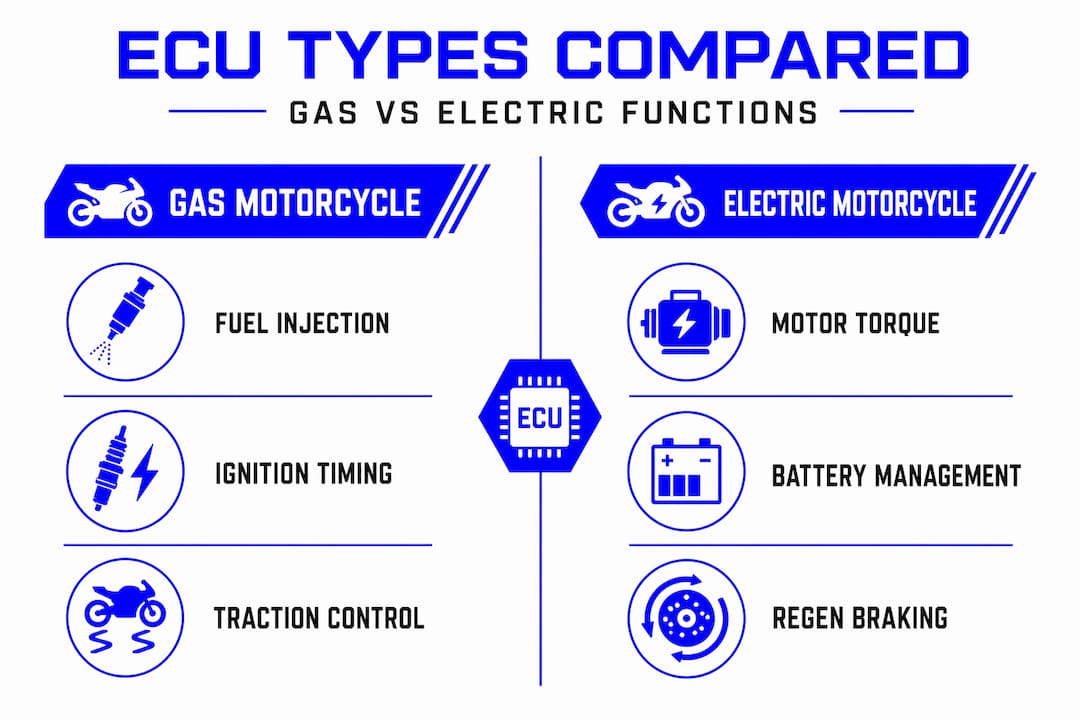
Electric motorcycle ECUs share the same basic concept but manage a different set of variables. Instead of controlling combustion, they regulate motor torque output, battery discharge rates, and regenerative braking. Understanding how controllers optimize performance on electric bikes shows how closely the ECU and motor controller work together to deliver smooth power delivery.
ECU tuning and remapping: unlocking real performance
From the factory, your ECU is not set up to extract maximum performance from your engine. Manufacturers calibrate stock ECUs conservatively to satisfy global emissions regulations and to accommodate varying fuel quality across different markets. That leaves a measurable gap between what your bike delivers and what it’s physically capable of.
ECU tuning, also called remapping or flashing, closes that gap. Here’s how the two main approaches differ:
- ECU flashing: A technician directly rewrites the factory software stored on the ECU chip. New fuel maps, ignition advance curves, and throttle response tables replace the factory defaults. This is the most thorough and permanent form of tuning.
- Piggyback tuners: These devices intercept sensor signals between your sensors and the stock ECU. Piggyback tuners modify sensor signals to trick the ECU into making different fueling decisions without actually rewriting any code. They’re less precise but work on bikes where the ECU can’t be flashed directly.
- Standalone ECU: When the factory unit is locked or incompatible with modifications, some riders replace it entirely with an aftermarket unit that offers full programmability.
- Dyno calibration: Any tuning method works best when validated on a dyno with an air/fuel ratio analyzer. Real-world data confirms the new maps are actually improving performance rather than just changing it.
Professional ECU flashing costs between $250 and $300, covering optimized fuel maps, ignition timing, and throttle response without any hardware changes. For that price, most riders see noticeable improvements in throttle feel, mid-range pull, and fuel efficiency, depending on the platform.
One limitation worth knowing: some modern ECUs are sealed or encrypted, which physically or electronically prevents reflashing. In those cases, a full ECU replacement with an aftermarket standalone unit is the only path forward.
The other nuance is architecture. The Bosch MG1 torque-based ECU doesn’t work with traditional fuel and ignition tables. Instead, it calculates a desired torque request and then reconciles airflow, load, and combustion efficiency dynamically to hit that target. Tuning this type of ECU incorrectly produces inconsistent throttle response, not a power increase.
Pro Tip: Before booking an ECU flash, confirm which ECU architecture your bike uses. Torque-based ECUs like the Bosch MG1 require tuners with specific experience in that platform. A generic flash tune from someone unfamiliar with the architecture can make the bike worse to ride, not better.
For a broader look at what’s possible with electric motorcycle tuning techniques, Revlinemods has a detailed breakdown covering both ECU modifications and hardware upgrades.
Electric bike ECUs: regenerative braking and energy recovery
Electric motorcycle ECUs operate in a fundamentally different world than their gasoline counterparts. They don’t manage combustion at all. Instead, they coordinate the flow of energy between the battery pack, the motor controller, and the drivetrain. The result is a control system that’s arguably more complex than what you’d find on a gas bike.
Here’s a comparison of key ECU functions across bike types:
| Function | Gas Motorcycle ECU | Electric Motorcycle ECU |
|---|---|---|
| Power delivery | Fuel injection and ignition timing | Motor torque and current output |
| Efficiency management | Air/fuel ratio optimization | State-of-charge and discharge rate |
| Braking control | Engine braking (limited) | Regenerative braking energy recovery |
| Thermal management | Coolant and fan control | Battery temperature and motor heat |
| Rider modes | Throttle maps and traction control | Regen levels and power profiles |
One of the most technically interesting functions of an electric bike ECU is regenerative braking. When you roll off the throttle or apply the brakes, the ECU switches the motor into generator mode, converting kinetic energy back into electricity and storing it in the battery. Fuzzy control algorithms for regenerative braking can improve energy recovery efficiency by 13 to 30% compared to simpler on/off approaches. That’s a meaningful gain in ride range on any platform.
Electric bike ECUs also handle predictive maintenance in ways that gas bikes are only beginning to adopt. Ducati’s predictive maintenance system uses ECU data on real-time engine load and RPM to calculate when valve checks and full services are actually needed, rather than defaulting to mileage-based intervals. The result: valve checks are triggered between 45 and 60 hours of real use, and full services between 90 and 120 hours.
For anyone getting started with the terminology around these systems, the electric motorcycle terminology guide from Revlinemods is a solid reference for understanding how ECU-related terms are used across different brands.
Recognizing ECU problems and keeping it healthy
A failing ECU doesn’t always announce itself dramatically. Most of the time it starts with small, easy-to-dismiss symptoms that gradually get worse. Knowing what to look for saves you from chasing unrelated problems.
Symptoms of a faulty motorcycle ECU include the following warning signs:
- Unexplained stalling: The engine cuts out at idle or under light load, often intermittently before becoming consistent.
- Check engine light: This is the ECU’s direct signal that one or more sensor readings are outside expected ranges.
- Sudden power loss: The bike feels flat or hesitant in a specific RPM range, often linked to corrupted fuel or ignition maps.
- Poor fuel economy: When the ECU can’t read sensor data accurately, it defaults to rich fueling that wastes fuel and wets plugs.
- Erratic idle: The engine hunts between high and low RPM at idle because the ECU is receiving conflicting inputs.
Not every ECU problem requires replacement. Many apparent ECU failures are actually sensor failures. A bad O2 sensor or TPS will produce symptoms identical to ECU failure, so always diagnose the sensors first before condemning the ECU itself.
For ongoing ECU health, the best practice is to avoid moisture exposure in the ECU housing, keep battery voltage stable to prevent corruption of ECU memory, and update ECU firmware when the manufacturer releases calibration improvements. The electric bike maintenance guide from Revlinemods covers practical steps for keeping all electronic systems, including the ECU, performing at their best.
My take on ECU myths and what actually matters
A lot of riders treat the ECU like a sealed black box that either works or doesn’t. In my experience, that thinking is what leads people into bad decisions: buying generic flash tunes, running piggyback tuners without understanding the underlying architecture, or replacing a perfectly functional ECU because a sensor was giving bad data.
What I’ve learned working with electric motorcycle builds and performance upgrades is that the ECU is not just a black box. It’s a reflection of your bike’s entire engineering philosophy. When you understand the architecture your ECU uses, whether that’s a torque-based system like Bosch MG1 or a traditional map-based controller, you can make genuinely informed decisions about what kind of tuning will actually help and what will introduce instability.
The uncomfortable truth is that most riders chasing peak power would actually enjoy riding more if they prioritized smooth throttle response over maximum horsepower numbers. A well-calibrated ECU that integrates cleanly with traction control and rider modes makes every ride better. A sloppy tune that squeezes out five extra horsepower but produces a jerky throttle transition is a step backward for real-world rideability.
My advice: understand your specific ECU before you touch it. Research whether it’s torque-based or map-based, whether it can be reflashed or requires a standalone, and what your actual riding goals are. That conversation with a qualified tuner will save you money and frustration.
— Revline
Upgrade your build after your ECU is dialed in

Once you’ve got a solid handle on your bike’s ECU and its tuning potential, the next step is making sure the rest of your build can keep up. Better throttle response and higher power output demand equally capable braking. At Revlinemods, we carry performance brake upgrades built specifically for electric motorcycles and off-road rigs. The Ultra Bee Brake Kit is one of our most popular picks for riders who’ve already sorted their ECU setup and want stopping power that matches their new performance level. We also carry dedicated e-bike brake upgrades compatible with platforms like Macfox, Super73, and Ridstar. Fast shipping, proven fitment, and parts designed for the way you actually ride.
FAQ
What is a bike ECU in simple terms?
A bike ECU, or Engine Control Unit, is the onboard computer that manages engine functions like fuel injection, ignition timing, and throttle response by processing real-time data from multiple sensors. On electric motorcycles, it also controls motor torque output and regenerative braking.
Can you tune a bike ECU for more power?
Yes. ECU tuning or remapping adjusts factory fuel maps, ignition timing, and throttle response to unlock performance that manufacturers limit for emissions compliance. Professional ECU flashing typically costs between $250 and $300 and can meaningfully improve throttle feel and power delivery.
How does an electric motorcycle ECU differ from a gas bike ECU?
An electric motorcycle ECU manages motor torque, battery discharge rates, and regenerative braking instead of combustion-related functions. It also handles energy recovery during deceleration, with advanced fuzzy control algorithms improving braking energy recovery efficiency by 13 to 30%.
What are the signs of a failing bike ECU?
Common signs include unexplained engine stalling, a check engine warning light, sudden power loss, poor fuel economy, and erratic idle behavior. Before replacing the ECU, always rule out sensor failures, since a bad TPS or O2 sensor produces nearly identical symptoms.
Is ECU remapping safe for my motorcycle?
ECU remapping is safe when done by a qualified tuner who understands your specific ECU architecture and validates changes on a dyno. Torque-based ECUs like the Bosch MG1 require platform-specific expertise, and generic flash tunes on these systems can produce inconsistent throttle behavior.